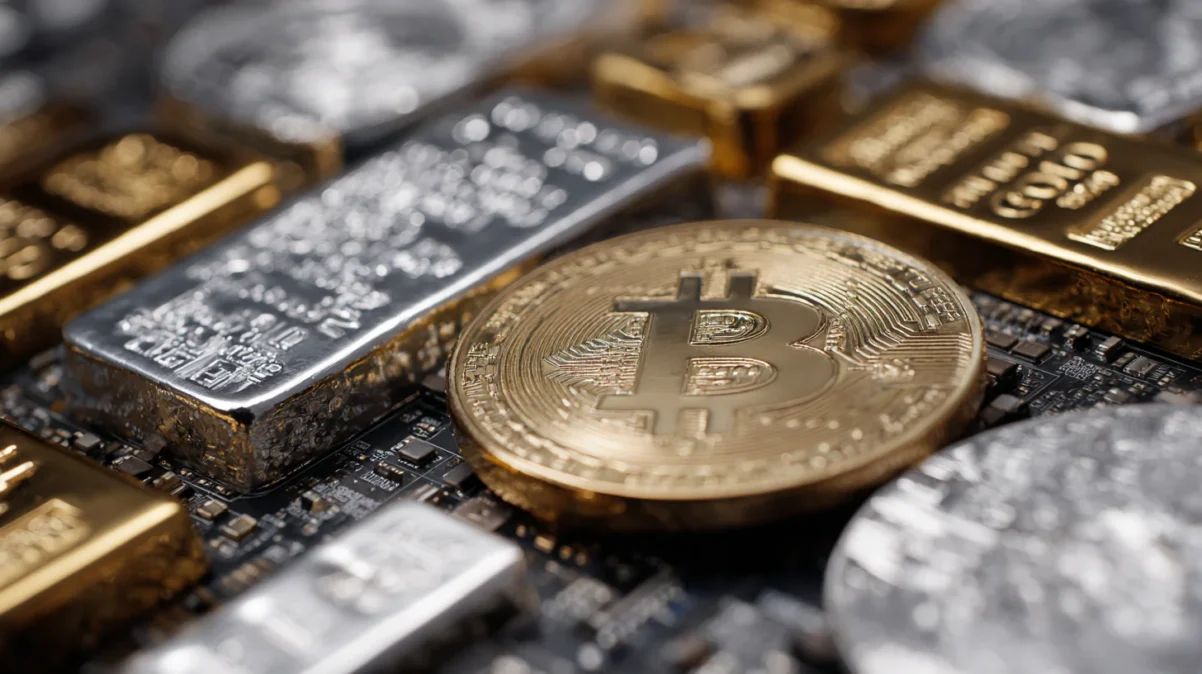
Gold, Silver and Bitcoin Fall: Why Markets Are Rethinking the Bet on Currency Depreciation
Financial markets rarely fall simultaneously without a reason. If one asset becomes cheaper, it may be a technical correction. If gold, silver, and bitcoin sharply retreat, it is worth looking deeper investors are not simply taking profits, they are reviewing the very idea on which a significant part of recent market bets was built.
Time for Action examined why precious metals and bitcoin came under pressure, how expectations regarding the policy of the Federal Reserve changed investor behavior, and why the reversal of the “bet on the depreciation of currencies” may become an important signal for the wider market. Gold and silver were long perceived as assets that should benefit in a world of high debt, budget deficits, and distrust of fiat currencies. The logic was simple: if states increase debt and currencies gradually lose purchasing power, investors look for protection in what cannot be printed by a central bank decision. This is how gold, silver, and partly bitcoin ended up in one market story the story of an escape from the depreciation of money. But this story began to break. Precious metals sharply retreated from their 2025 highs. Gold, which reached a January peak of around 5,600 dollars per ounce, fell by approximately 28% and dropped below 4,000 dollars. Silver, which moved even more aggressively, lost more than 50% and fell below 59 dollars per ounce.
For the market, this is not simply a fall after strong growth. It is a signal that investors have begun to assess differently the future value of money, the yield of safe instruments, and the role of assets that do not generate regular income. The main blow to metals came from expectations regarding the Federal Reserve. The market began to price in the probability of tighter monetary policy under the leadership of the new Fed chair Kevin Warsh. Investors are already factoring in two rate hikes of 25 basis points by March 2027. This could raise the federal funds rate to the 4.00–4.25%range.
For gold and silver, such a change in expectations is painful. When rates are higher, the attractiveness of the dollar and instruments that provide income increases. Bonds, deposits, short-term debt securities all of this begins to look more convincing compared with assets that do not generate interest. Gold can protect against fear, but it does not pay a coupon. Silver can be a bet on industrial demand and monetary distrust, but it also does not provide regular income. That is why a change in rates is not a technical detail, but a change in gravity for the entire market. In 2025, investors actively played the idea that in the West is called the debasement trade. In Ukrainian, it is more accurate to say a bet on the depreciation of fiat currencies. Its basis is the belief that large public debts, chronic budget deficits, and loose monetary policy over time undermine the real value of money. In such a model, gold, silver, and bitcoin were supposed to look like natural winners.
But the market is always dangerous because it can sharply change the question. Yesterday investors were asking: “How can one protect oneself from the depreciation of currencies?” Now another question is being heard more and more often: “What will happen if rates remain high longer than expected?” This is an entirely different game. If the main fear is the depreciation of money, gold and silver receive support. If the main fear becomes a tougher Fed policy, a stronger dollar, and higher yields, those same assets begin to lose part of their attractiveness. The investor is no longer simply looking for protection. The investor compares: hold an asset without income or move into an instrument that pays for waiting. Bitcoin looks the most complicated in this story.
For a long time, it was being placed next to gold: limited issuance, independence from central banks, protection from the devaluation of fiat currencies. But bitcoin’s behavior increasingly shows that the market does not always perceive it as digital gold. Often, it behaves closer to a risky technology asset: it rises when investors are ready to take risks and falls when liquidity tightens. During a significant part of 2025, bitcoin held near 100,000 dollars, while gold and silver were actively rising. This divergence already then put an uncomfortable question before the market: if bitcoin is truly protection from the depreciation of currencies, why does it not repeat the movement of metals?
Now the question has become even sharper. Bitcoin continued its decline during the wider correction and dropped below 62,000 dollars. This is approximately a 50% retreat from the all-time high recorded in October. An additional technical signal is trading below the long-term 200-week moving average, which is near 62,800 dollars. For the crypto market, this is an important level not only from the point of view of the chart. Such marks often influence investor psychology. When an asset breaks below long-term averages, part of the market begins to perceive the fall not as a short drawdown, but as a sign of deeper weakness. At the same time, bitcoin cannot be described only as a weak asset. There is another side as well. From its February lows, it outperformed both precious metals: it rose by approximately 30% against gold and by more than 55% against silver. In other words, within this trio bitcoin looked stronger in certain periods. The problem is different: all three assets lost to American stocks in 2026. And this may be the most important part of the entire story.
Money did not simply leave metals and cryptocurrency. It found another center of gravity American stocks, especially companies connected with semiconductors and memory. This means that the market has not abandoned risk completely. It has become more selective. Investors are not necessarily fleeing into protection. They are shifting capital to where they see stronger momentum, a clearer growth story, and a better link to the technology cycle. This is an important point. The fall of gold, silver, and bitcoin does not necessarily mean global panic. It may mean a change of favorites. Assets that benefited from fear of the depreciation of currencies are giving way to assets that benefit from expectations of technology profits. The market has not stopped looking for profit. It has changed the explanation of why exactly it can be found there. For gold, this is a test of status. It remains a traditional protective asset, but even gold is vulnerable when the dollar strengthens and rates become more attractive. For silver, the situation is even harsher, because it depends not only on monetary expectations, but also on industrial demand. That is why its movements are often sharper both upward and downward.


For bitcoin, this is a test of identity. If it is protection from the depreciation of fiat currencies, it should behave closer to gold in moments of distrust of money. If it is a risky asset, its fall during expectations of a tougher Fed policy looks logical. It is precisely this duality that makes its behavior so important for investors. The most interesting thing in the current reversal is not the price fall itself. Markets always correct after strong moves. Something else is more important: investors have begun to doubt the story that only recently looked almost without alternative. If fiat currencies are depreciating, one should buy gold, silver, and bitcoin. If debts are rising, one should hold assets outside the system. If central banks weaken, those who do not depend on them will win. But now the market reminds us: even a strong idea does not work forever if the price of money changes.
Expectations of higher rates return investors to the basic question: how much does it cost to wait? When money is cheap, an asset without income can seem attractive. When money again has a price, the investor begins to demand more arguments. That is why the fall of gold, silver, and bitcoin should be perceived not only as a market correction. It is a test for the major investment idea of the recent period. Does the fear of the depreciation of currencies really remain the main theme? Or has the market already moved into a new regime, where rates, the dollar, liquidity, and technology profits become decisive? For now, the answer looks like this investors have not abandoned protective assets forever, but they have stopped paying any price for them. And this may be the main signal. The market is entering a phase where one loud narrative is no longer enough. Gold will have to prove its role in a world of higher rates. Silver will have to withstand the blow between monetary expectations and the industrial cycle. Bitcoin will have to answer again the question of what it is for big money: protection from the system or part of the risky market. And investors will have to get used to a less comfortable reality: in a world where money again has a price, even “eternal” protective stories can fall quickly.
About the Author

Related posts:
 Gold Fell to a Two-Month Low: Why War and Expensive Oil Did Not Save the Metal From Fed Pressure
  Bitcoin Depends on More Than the Crypto Market: Why U.S. Treasury Operations May Pressure the Price
  Bitcoin Without Panic: Why the Crypto Market Is Not Mirroring the Behavior of Stocks and Oil During War
  Can Bitcoin Become a Reserve Asset for Governments