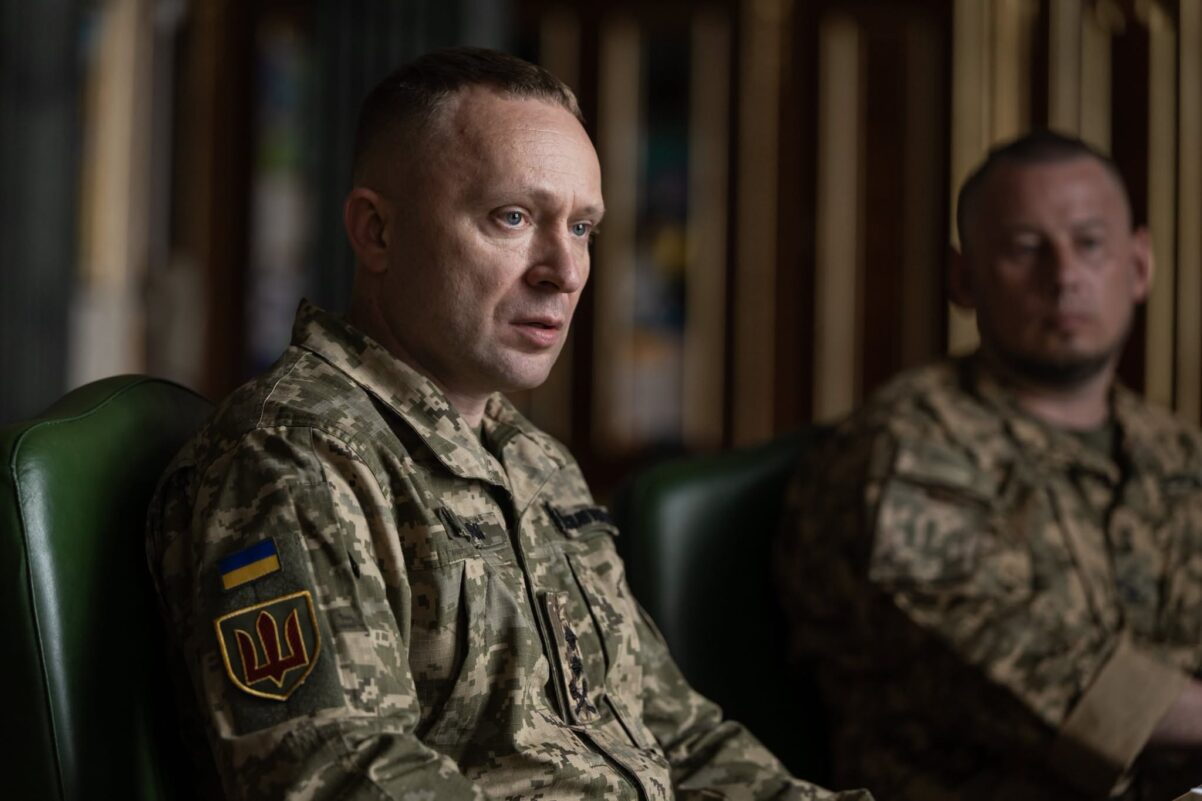
Mykhailo Drapatyi to Replace Syrskyi as Ukraine’s Commander-in-Chief
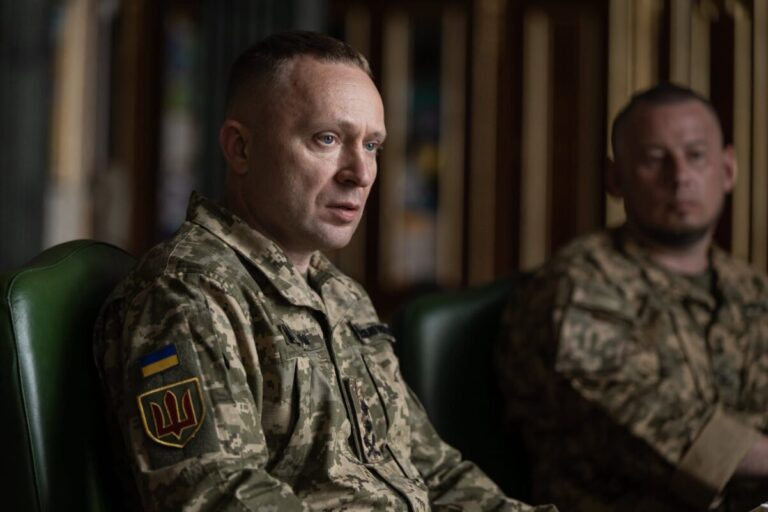
On July 21, President Volodymyr Zelenskyy announced the dismissal of Oleksandr Syrskyi as Commander-in-Chief of the Armed Forces of Ukraine. Major General Mykhailo Drapatyi will become the new head of the Armed Forces. The president announced that the personnel decisions would be formalized the following day. The change of commander-in-chief comes alongside an overhaul of the General Staff, the preparation of a new defense strategy, and the continuation of the corps reform. Drapatyi is expected to maintain stable command of combat operations, fulfill the requests of military units, and provide a clear vision for the mobilization process.
Time for Action analyzed why Mykhailo Drapatyi was selected, what tasks he has received, and whether there are sufficient grounds to link Syrskyi’s dismissal to protests in Ukrainian cities.
“I have decided that Mykhailo Drapatyi will become the new Commander-in-Chief of the Armed Forces of Ukraine. Together with Mykhailo, Yevhen Khmara, and Pavlo Palisa, we determined how the configuration of the General Staff of the Armed Forces of Ukraine should be updated.”
A key detail in Zelenskyy’s statement was the simultaneous renewal of several levels of military command. The president did not limit the announcement to the name of the new commander-in-chief. He reported forthcoming changes to the General Staff and the involvement of commanders with combat, managerial, and technological experience. Before making the decision, Zelenskyy held meetings with commanders of army corps, the Marine Corps, Operational Group East Commander Viktor Nikoliuk, and other members of the senior military leadership. Among those involved in the consultations, the president named Apostol, Redis, Biletskyi, Horbatiuk, Obolienskyi, and Brovdi. According to Zelenskyy, the discussions covered priorities and the further modernization of army command. This indicates that the personnel decision was preceded by talks with commanders at various levels who are directly responsible for combat units and individual sections of the front. Syrskyi’s dismissal was presented as a managed transfer of authority. The president’s statement contains no accusations of failed operations or improper performance of duties. On the contrary, Zelenskyy mentioned Syrskyi’s achievements during the defense of Kyiv, the Kharkiv offensive operation, and the Kursk operation.
“The fact is that Oleksandr Syrskyi delivered results for Ukraine in the defense of Kyiv, in the Kharkiv offensive operation, and in the Kursk operation. A significant path has been traveled, Ukraine’s defense continues, and every warrior needs to be treated with dignity. I am grateful to Oleksandr Syrskyi and every one of our warriors for Ukraine’s strong frontline positions. I am grateful to Mykhailo Drapatyi for exactly this view. Today, Oleksandr Syrskyi, Andrii Hnatov, and I discussed future formats of service and the proper transfer of responsibilities.”
The reference to possible future formats of service for Syrskyi means that his experience may continue to be used after he leaves the position of commander-in-chief. The president did not name a specific position or new area of work. Zelenskyy paid particular attention to the continuity of military command. Changing the commander-in-chief during active operations requires the rapid transfer of information, authority, and current plans. This is why the president specifically emphasized a coordinated and institutional transition.
“Mykhailo Drapatyi and I have determined which tasks must be implemented in the immediate and medium-term future. The operations of Ukraine’s Defense Forces are continuing and must continue steadily. Ukraine’s plan of long-range sanctions and our mid-strike program will be implemented with absolute precision. All military affairs must be transferred in the most coordinated and institutional manner, and the planned steps in combat operations must continue.”
Drapatyi’s first task will be maintaining the stability of military command. Planned operations must continue without interruptions caused by the personnel overhaul. The president also confirmed that Ukraine’s long-range strike and so-called mid-strike programs would continue. The second area will be the preparation of an updated defense strategy. Yevhen Khmara and other commanders selected by the military and political leadership are expected to join Drapatyi in this work. The strategy must be submitted for approval, although no deadline for its preparation has yet been announced. The third task concerns the continuation of the corps reform. The president included it among the immediate priorities of the new Armed Forces leadership. He did not disclose a detailed model of the forthcoming changes, so it is too early to assess the specific distribution of authority between the corps and the General Staff.
Another area will be fulfilling combat commanders’ requests for weapons, drones, and equipment. These needs were discussed during meetings of the Staff of the Supreme Commander-in-Chief and direct meetings with commanders. Including this issue among Drapatyi’s priority tasks shows that the new military leadership must strengthen the connection between the needs of military units and decisions made by the General Staff. The priorities also include protecting Ukrainian airspace from Russian strikes and preparing a clear vision for the mobilization process. Zelenskyy did not say what specific changes could be introduced to mobilization. The new commander-in-chief is expected to provide concrete proposals that will become part of the overall defense strategy. The choice of Mykhailo Drapatyi is linked to his extensive experience commanding combat and operational groups. He has progressed from commanding a mechanized unit to leading the Joint Forces of the Armed Forces of Ukraine.
Drapatyi was born on November 21, 1982, in Kamianets-Podilskyi. In 2004, he graduated from the Kharkiv Institute of Tank Forces, received the rank of lieutenant, and began serving in the 72nd Separate Mechanized Brigade. When the war began in 2014, he commanded the brigade’s 2nd Mechanized Battalion. One of the best-known episodes of his service was the operation to liberate the police building in Mariupol, which had been seized by pro-Russian militants. Drapatyi personally drove the infantry fighting vehicle that broke through the barricades. In June 2014, his battalion took part in a raid along the Ukrainian-Russian border aimed at cutting off militants’ supply routes. Ukrainian units came under intense shelling from Russian territory and found themselves in a difficult position near Izvaryne and Chervonopartyzansk. Drapatyi led the withdrawal of the troops from the area. From 2016 to 2019, he commanded the 58th Separate Motorized Infantry Brigade. At the same time, he studied at the National Defense University of Ukraine, where he received a master’s degree in 2017.
Following the beginning of Russia’s full-scale invasion, Drapatyi led the defense of Kryvyi Rih in March 2022. He later headed Operational Group Kherson and was among the commanders who led the liberation of the right-bank part of the Kherson region. In February 2024, Drapatyi was appointed Deputy Chief of the General Staff of the Armed Forces of Ukraine for military training. From May to September of that year, he headed Operational Group Kharkiv, which worked to stabilize the situation following the Russian offensive. Drapatyi later commanded Operational-Tactical Group Luhansk. On October 5, 2024, he was promoted to major general. In November, he became Commander of the Ground Forces of the Armed Forces of Ukraine. Following a Russian missile strike on the Cherkaske training ground in the Dnipropetrovsk region, Drapatyi submitted his resignation. He later said that he would remain in the military, and in June 2025, he was appointed Commander of the Joint Forces of the Armed Forces of Ukraine. He has been awarded the Order of Bohdan Khmelnytsky and holds the People’s Hero of Ukraine distinction.
Drapatyi’s experience includes command at the battalion, brigade, operational group, Ground Forces, and Joint Forces levels. He has also worked in the General Staff and was responsible for military training. This combination of frontline, staff, and training experience corresponds with the tasks Zelenskyy has assigned to the new commander-in-chief. The personnel decision was preceded by a broader political reshuffle. On July 14, the Verkhovna Rada supported Yuliia Svyrydenko’s resignation as prime minister. The entire Cabinet of Ministers resigned along with the head of government. One of the main personnel questions concerned the future of Defense Minister Mykhailo Fedorov.
Before the decisions were announced, media reports emerged about a possible conflict between Fedorov, Syrskyi, and part of the military leadership. Ukrainska Pravda, citing sources in the Servant of the People parliamentary faction, reported that the president did not plan to nominate Fedorov again as defense minister. The Economist also reported that some military leaders did not support certain reforms. These reports did not confirm an official decision regarding Syrskyi. On July 20, after information emerged that his dismissal was being prepared, the General Staff stated that the commander-in-chief continued to perform his duties. The following day, Zelenskyy announced the change in the leadership of the Armed Forces.
From July 16 to 19, peaceful demonstrations were held in Ukrainian cities against Fedorov’s dismissal as defense minister. Protesters also demanded Syrskyi’s resignation. The demonstrations created visible public and political pressure, but there is no direct evidence that they caused the change of commander-in-chief. In his address, Zelenskyy did not identify the protests as the reason for the personnel decision. The president explained it through the results of consultations with military leaders, the need to modernize command, and the preparation of an updated defense strategy. It would therefore be unfounded to claim that Syrskyi was dismissed solely because of the demonstrations. It is accurate to say that the protests preceded the decision and increased public attention to personnel disputes within the military leadership. The technological direction is expected to hold a separate place in the future system. Zelenskyy reported meeting with Mykhailo Fedorov and offering him another government position that would allow him to unite the state’s technological components. The president has not yet announced the title of the position or the scope of its authority.
Yevhen Khmara is also involved in preparing the decisions. Zelenskyy linked his experience to the work of the Alpha unit, technological results, and long-range strikes. The full composition of the updated General Staff has not yet been presented, so the final division of responsibilities between Drapatyi, Khmara, Palisa, and other commanders will become clear after the decisions are formalized. The change of commander-in-chief opens a new stage for military command, but its results will be determined by the implementation of specific tasks. These include the stability of combat operations, the continuation of the corps reform, supplying units with weapons and drones, protection against Russian strikes, the development of long-range capabilities, and clear decisions on mobilization. Mykhailo Drapatyi takes office at a time when the military leadership, government, and defense strategy are all being updated. His appointment is based on his experience commanding units and operational groups across different sections of the front. The first measure of the new commander-in-chief’s performance will be his ability to complete the transfer of responsibilities without disrupting the command of troops or the execution of already planned operations.
About the Author

Related posts:
 Protests in Support of Fedorov Spread Across Kyiv and Other Ukrainian Cities
  Anti-Shahed Defense System: How the Armed Forces of Ukraine Are Expanding Their Capabilities Against Kamikaze Drones
  I Forum on Military Law: How Ukraine Is Shaping Legal Solutions for the Army and Society During Wartime
  Zelensky Reshuffles Key Roles: Who Was Replaced, Why It Matters, and What Comes Next