Solar Panels on a Balcony Do Not Provide Energy Independence, but a Reserve for When the Lights Go Out
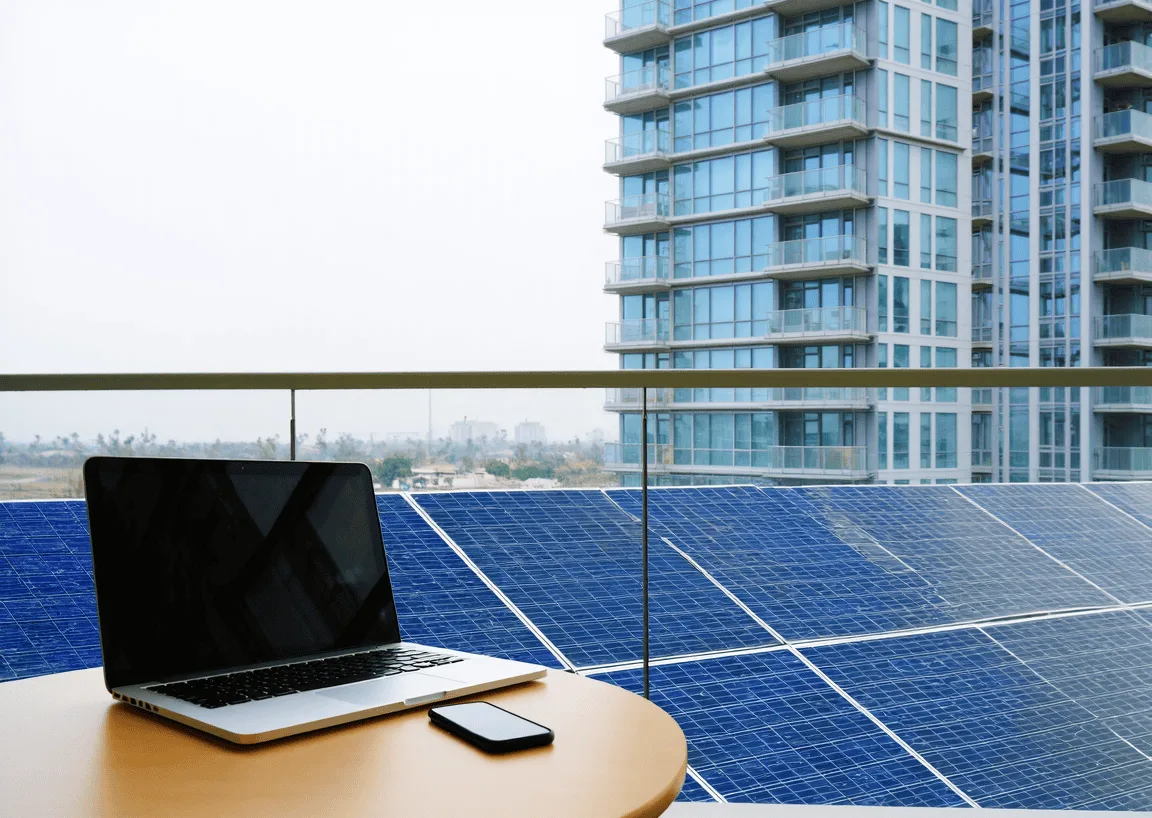
After mass power outages, Ukrainians began looking not for ideal solutions, but for practical ones that could provide basic household autonomy. Generators remain nearly impossible for apartment living, large rooftop solar systems are not available to everyone, and standard portable power stations have limited reserves. Against this background, another option has started drawing more attention solar panels on the balconies of apartment buildings. A few years ago, this format in Ukraine was still seen as something unusual. By late 2025 and early 2026, interest in it had grown noticeably. The reason is simple after previous blackouts, many apartments already had hybrid inverters and battery systems installed. Some of that equipment is already capable of working not only as backup power, but also together with small-scale solar generation. That is why a balcony mini-solar station for some urban apartments has stopped being theory and become a practical scenario.
“Time for Action” examined whether solar panels on a balcony can really provide autonomy for an apartment, how much it costs, and why the main issue here is not only money, but also physics, safety, and realistic expectations. The main thing to understand immediately is this a balcony solar station does not turn an apartment into an автономous house. It is not a full replacement for the grid and not a way to live entirely without outside power. It is a backup solution for basic needs when electricity disappears. That is its practical purpose. A balcony solar system is not designed to power the entire apartment. It is not built for an electric stove, kettle, boiler, air conditioner, or coffee machine. It serves a different task: to provide enough stored electricity for what is critical to get through a day without grid power a refrigerator, router, lighting, phone charging, and small appliances. If viewed without inflated expectations, the logic of such a system is entirely clear. It is not a way to save money, but a way to reduce dependence on outages. Not a tool for full energy independence, but a household reserve.
Financially, this is not a cheap solution. One 400 W solar panel costs about $100. A 5 kWh battery costs roughly 40,000-50,000 hryvnias. A quality 5 kW inverter adds another 38,000-40,000 hryvnias. With three or four panels included, a full hybrid setup for an apartment can cost up to 100,000 hryvnias. That matters, because a balcony solar station is not about quick payback. Under current electricity tariffs, it is not really an efficiency investment. Its main value is not in lower utility bills, but in the fact that when the power goes out, basic electricity remains available in the apartment. That is why it should be assessed not as a way to earn or quickly recover costs, but as an investment in household resilience. But even with the money available, the key factor is not budget, but physics. The efficiency of such a system depends entirely on where the balcony is located. The best-case scenario is a south-facing side with no shading from trees, nearby buildings, or structural elements. Under those conditions, four 400 W panels can generate around 3 kWh in spring or autumn, and up to 5 kWh in summer. That is enough to store energy in a battery and support basic appliances for a full day.
But this model works only under good conditions. If the panels are partially shaded, if the balcony does not face the sunny side, or if the facade is blocked by another building, system efficiency drops sharply. In some cases by as much as eight times. And that is where the main line lies between a working solution and an expensive disappointment. Two apartments may spend the same amount and get completely different results. In one, the system provides stable backup during outages. In another, it delivers only minimal charging that does not justify the cost. The problem is not only the amount of sunlight, but also the installation format itself. Solar panels work best at a tilt angle of around 15-25 degrees. On the facade of an apartment building, they are often mounted almost vertically, at an angle close to 90 degrees. That means lower efficiency compared with a standard rooftop system.
In other words, a balcony solar station will almost always perform worse than a rooftop one. The only real question is whether it provides enough for the needs of a specific apartment. If the goal is minimal backup it can. If expectations are higher it cannot. Another issue is seasonality. In winter, solar generation is significantly lower. At the exact time when the risk of energy shortages is higher, the efficiency of such panels declines. In summer they work better, but summer usually comes with fewer and shorter outages. That does not make the system useless, but it clearly shows its limits. Another critical factor is safety. And this may be the most important part of the entire setup. A balcony solar station is not simply a panel that can be casually attached to a facade. It involves exterior mounting, weight, wind load, electricity, and liability.
If the panel is mounted incorrectly, a strong gust of wind can tear it loose. If it falls, the owner is responsible. If the inverter or battery is connected incorrectly, there is a real risk of short circuit or fire. That is why self-installation is the most dangerous scenario here. These systems require not a household-level approach, but a proper engineering solution a mounting design, safe installation, and professional electrical connection. There is also a legal issue. The facade of an apartment building is not entirely private space. Any modification to it requires approval. That means installing panels is not only a technical issue, but also a legal one. That is why a balcony solar station works as a targeted solution, but not as a universal model for everyone.


For an individual apartment, it can make sense if several conditions align at once a sunny side, minimal shading, a real need for backup power, and a willingness to invest not in payback, but in autonomy. For an apartment building as a whole, a much stronger solution is not an individual one, but a collective one. A shared rooftop solar system with batteries for the building can provide much more: power for pumps, lighting, heating, basic building infrastructure, and a shared backup point where residents can charge phones and portable batteries. That is not only more efficient, but also more rational in terms of cost, safety, and benefit for the entire building. Solar panels on a balcony do not provide full energy independence. They provide a reserve of time, light, and connectivity when electricity disappears. And that is their real purpose. This is not a universal solution and not a home power station in the full sense. It is a compromise expensive, limited, but functional for basic autonomy. It does not solve everything, but in an unstable energy system it can provide what matters most in a critical moment: a few hours of calm, light in the room, and a charged connection to the outside world.
About the Author

Related posts:
 Solar panels are becoming more expensive again: how the market is changing and what it means for Ukraine
  Power Outages in Autumn 2025: How the Energy Sector Changes Under the Pressure of Attacks
  COR-Energy: Ukraine’s First Autonomous Solar-Powered Gas Station and Its Unique Innovations
  Solar Energy in Ukraine: What Works Today and Which Technologies Will Shape the Market by 2030