NATO Summit in Ankara: How Ukraine Is Becoming a Weapons Production Partner
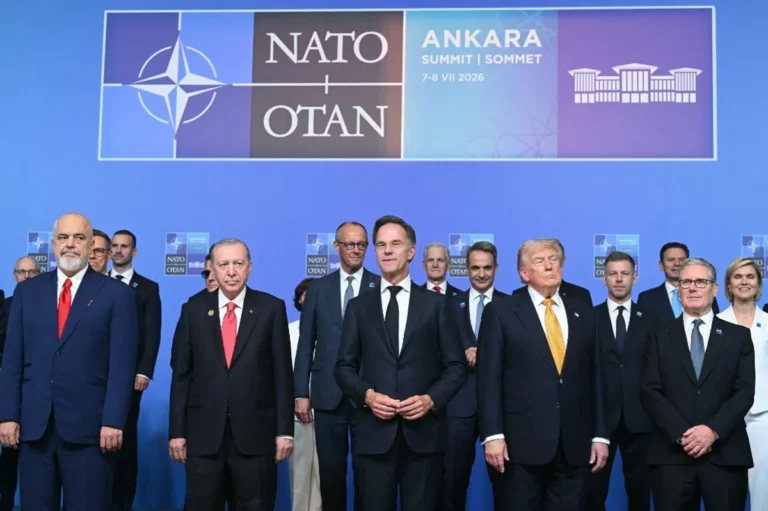
The NATO summit, which concluded in Ankara on July 8, marked an important change in the allies’ approach to supporting Ukraine. This is no longer only about transferring individual weapons packages or providing funding for a limited period. Western states are moving toward a long-term model that combines multi-year financing, modernization of the Ukrainian military, joint production, technology transfers, and the gradual integration of Ukraine’s defence industry into Europe’s security system. The official recognition of Russia as a long-term threat means that the Alliance no longer views the war against Ukraine as a temporary crisis that can be resolved by a single political decision. NATO is effectively proceeding from the assumption that the Russian threat will persist regardless of how long the fighting continues and will therefore require permanent deterrence, significant military spending, and the development of defence capacity in Europe. Time for Action analyzed how the summit’s decisions are changing Ukraine’s role in relations with its partners and why the main outcome of the meeting may be not only new assistance, but also a transition to joint weapons production.
€140 Billion as the Foundation for Long-Term Planning
The summit’s largest financial decision was a €140 billion support package for Ukraine over two years. The funds are expected to be divided equally: €70 billion in 2026 and another €70 billion in 2027. Oleksandr Musiienko, head of the Centre for Military and Legal Studies, emphasized:
“We will receive €140 billion for the next two years. €70 billion for 2026. €70 billion for 2027. This step guarantees stability for Ukraine’s defence sector over the long term.”
For Ukraine, the significance of this decision lies primarily in predictability. One-off packages make it possible to meet urgent needs, but they complicate long-term planning for procurement, production, and military modernization. A two-year financial horizon makes it possible to determine order volumes in advance, conclude longer contracts, and plan the development of production capacities. For the defence industry, this is also a signal that demand for weapons and components will not be limited to a single budget year. Companies gain stronger grounds to invest in new production lines, expand their workforces, and increase output without the risk that financing will suddenly stop after the latest aid package ends. At the same time, the amount of money alone does not guarantee a result. The schedule of funding, the structure of expenditures, and the allies’ ability to fulfil their commitments will be decisive. For Ukraine, it is important that financial support turns into specific deliveries, production contracts, technical modernization, and stable supplies for the military.
Assistance Is Moving From Warehouses to Production Lines
One of the main changes recorded at the summit is the gradual transition from supplying ready-made weapons to joint production. Previously, support for Ukraine depended heavily on allied stockpiles. This model has a natural limit: warehouses are not infinite, while European industrial capacity for a long time did not match the scale of the war. The new agreements are intended to change this logic. Ukraine gains the opportunity to use European factories, investments, and technological capacity, while its partners gain access to Ukrainian developments and combat experience. This is especially important for unmanned systems. Ukraine’s defence industry is constantly improving drones, control systems, and methods of their use. However, production inside the country remains under permanent threat from Russian strikes and depends on access to imported components. Deploying part of the production capacity in Europe would simultaneously increase output, distribute risks, and create more stable supply chains.
Drone Deal Turns Ukraine’s Combat Experience Into a Strategic Resource
During the summit, Ukraine concluded three agreements in the field of unmanned technologies with Denmark, the Netherlands, and Estonia. The agreements were named Drone Deal, but their significance extends far beyond the procurement of individual drone models. The agreement with Denmark was defined as a new stage of strategic cooperation in the production and development of unmanned systems. The details have not been disclosed, but the format itself indicates an intention to establish long-term production links. The agreement with the Netherlands provides for joint drone production, the exchange of technology and innovation, and the expansion of defence capacity. For Ukraine, this cooperation is particularly important because of the Netherlands’ access to advanced technologies and its developed industrial base.
Oleksandr Musiienko noted that the Ukrainian military critically needs such innovations. Joint work could accelerate access to essential components and help launch new types of equipment into production more quickly. The agreement with Estonia gives Estonian companies access to Ukraine’s combat experience and provides for the possibility of deploying drone production based on Ukrainian technologies. It also creates a foundation for future procurement of Ukrainian products.
Estonian Prime Minister Kristen Michal emphasized that Ukraine is no longer only receiving security, but is also becoming a provider of security for Europe. This assessment accurately reflects the change in Ukraine’s role. During the first years of the full-scale war, Kyiv primarily acted as the party requesting weapons and funding. Now Ukraine is increasingly offering its partners technologies tested under the most difficult combat conditions. Drone Deal is therefore not charity. It is a mutually beneficial partnership in which European states gain access to the experience of modern warfare, while Ukraine gains access to investments, factories, components, and the ability to scale its own solutions.
Air Defence Production Licences Change the Level of Trust
Another important result was Ukraine’s receipt of licences for the joint production of components for air defence systems. The transfer of such rights has both political and military significance. Licensed production represents a higher level of trust than the ordinary delivery of finished products. Partners are effectively granting Ukraine access to technologies that were previously kept under strict control by manufacturers and owner states. Political technologist Taras Zahorodnii described this as recognition of the effectiveness of Ukraine’s defence-industrial complex.
“The Americans see that what Putin was telling Trump in Anchorage turned out to be the ‘spirit of Anchorage,’ not reality. They see Ukraine’s effectiveness. The United States wants to deal exclusively with winners.”
In his assessment, the United States’ willingness to purchase Ukrainian drones is a genuine mark of quality for Ukrainian weapons. The more Ukraine develops its own production and delivers results on the battlefield, the more grounds partners have to transfer licences and launch joint projects. For Kyiv, this is also important because licensed production reduces dependence on political decisions concerning each individual delivery. If Ukraine can manufacture air defence components independently or jointly with allies, it will gain more stable access to critically important weapons. However, implementing such agreements will take time. Production facilities, equipment, certification, components, and protected supply chains will all be required. Licences are therefore primarily a strategic investment rather than an immediate way to meet every air defence need.
Canada Strengthens Air Defence, Energy, and Reconstruction
Canada announced a new aid package worth 900 million Canadian dollars. It is expected to include ammunition, military equipment, air defence systems, and support for Ukraine’s energy sector and reconstruction. The combination of military and civilian assistance shows that partners view Ukraine’s resilience more broadly than its ability to conduct combat operations. Russia systematically attacks energy infrastructure, so support for generation, grids, and reconstruction directly affects the state’s defence capacity. Volodymyr Zelenskyy said that a large Canadian air defence package had already arrived in Ukraine and that new deliveries were on the way. Unlike long-term production agreements, this decision has a faster practical effect and can directly strengthen the protection of Ukrainian cities.
Belgian F-16s Depend on the Transition to F-35s
Belgium confirmed its readiness to transfer almost its entire fleet of F-16 fighter jets to Ukraine after completing the rearmament of its own Air Force. Ukraine is expected to receive four Belgian aircraft this year. The transfer of the remaining jets will depend on the pace at which Belgium receives F-35s. Defence Minister Theo Francken explained:
“We will transfer practically all of our F-16s to Ukraine. But first we must receive the F-35s, because we perform an important role in NATO’s nuclear deterrence system. Only after that will we be able to transfer the F-16s.”
This statement is important, but it must be assessed with the timing condition in mind. Belgium cannot give up its F-16s before completing the transition to new fighter jets because the aircraft remain part of its obligations within NATO’s nuclear deterrence system. The nearest practical result is therefore the transfer of four aircraft. Almost the entire Belgian fleet is a longer-term prospect that will depend on Belgium’s own rearmament. For Ukraine, such agreements matter not only because of the number of fighter jets. They also make it possible to plan the future structure of the air force, pilot training, maintenance, and spare-parts stocks.
Russia Will Try to Target Relations Between Ukraine and Poland
Alongside the defence agreements, the summit also addressed future contacts between Volodymyr Zelenskyy and leaders of neighbouring states, including Polish President Karol Nawrocki. Ukrainian-Polish relations remain one of the key elements of security on Europe’s eastern flank. Poland is an important logistical, military, and political partner for Ukraine. That is why Russia is interested in creating conflicts between the two states. Diplomat and international affairs expert Vadym Triukhan warned of possible provocations during commemorations of the victims of the Volyn tragedy on July 11.
“The Russians are pouring enormous amounts of money into setting Ukrainians and Poles against each other. I am convinced of this, and moreover, I am convinced that they will do everything to organize some kind of provocation. The security bodies of both countries must act in a coordinated manner.”
Russia’s strategy in this area involves exploiting historical trauma, radical rhetoric, and domestic political competition. Certain forces may try to gain electoral support by intensifying disputes with Ukraine. At the same time, most Polish politicians, according to Triukhan, support dialogue. This means that the main task for Kyiv and Warsaw is not to avoid difficult issues, but to prevent Russian propaganda from using them to destroy the strategic partnership.
The Summit Changed Not Only the Scale of Assistance, but the Entire Model of Relations
The outcomes of Ankara are important not because of any single figure or statement, but because of how they fit together. Ukraine is receiving long-term financing, new weapons packages, the prospect of additional F-16 deliveries, licences to manufacture air defence components, and agreements on joint drone production. Together, these decisions form a new support model. Its first component is predictable financing. The second is weapons deliveries to meet current needs. The third is the development of production that should supply both Ukraine and its allies over the longer term. The fourth is the use of Ukrainian combat experience as a resource for European security. The fourth element is fundamentally new. Ukraine is no longer only a consumer of Western security. It is becoming a source of technologies, tactics, and production solutions that European states themselves need.


What the Summit’s Decisions Will Give Ukraine
The nearest result will be new deliveries of ammunition, equipment, air defence systems, and four Belgian F-16s. This strengthens Ukraine’s defence now. The medium-term result will be increased drone production and access to European factories, components, and investments. This will allow more weapons to be produced and reduce dependence on manufacturing located exclusively inside Ukraine. The long-term result will be the formation of a joint defence-industrial system in which Ukrainian companies work together with their partners and Ukrainian technologies become part of European security. However, realizing these opportunities depends on the implementation of the agreements. Political statements alone are not enough. Contracts, financing, operational production lines, transferred technologies, and defined delivery schedules are required.
The main outcome of the NATO summit in Ankara is that support for Ukraine is moving from temporary decisions to a long-term system. The allies are preparing not only to transfer weapons, but also to produce them together with Ukraine, invest in its defence industry, and use Ukrainian experience to strengthen their own security. This does not eliminate Kyiv’s dependence on partner assistance or guarantee the automatic fulfilment of every agreement. But Ukraine’s role is gradually changing. It is becoming not only a state that must be defended, but also a country capable of creating technologies and defence solutions for all of Europe. This change may prove more important than any individual aid package. In a long war, what matters most is not a single delivery, but the ability to continuously produce weapons, modernize the military, and preserve political unity among allies. The decisions taken in Ankara create the foundation for that.
About the Author

Related posts:
 Ministry of Defence Transfers Military Technologies to Manufacturers for Serial Production
  Ukrainian Drones Are Becoming an Instrument of Defence Diplomacy
  US-China Summit in Beijing: What Trump and Xi Are Negotiating and Whether Ukraine Is on the Agenda
  Europe’s Defense Industry: How War and EU Programs Accelerated Arms Production