Trump, Merz and American Troops in Germany: Why the Dispute Over Iran Went Far Beyond a Diplomatic Clash
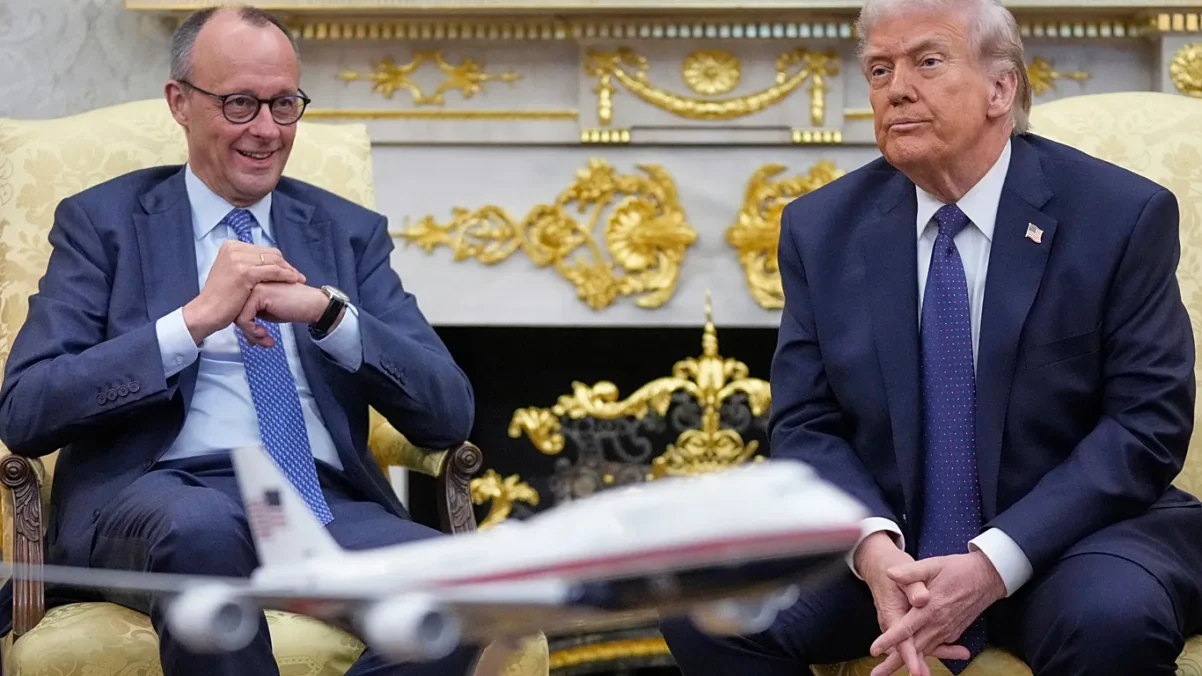
The dispute between Donald Trump and Friedrich Merz began as a public exchange of sharp statements over the war in Iran, but quickly grew into a much broader discussion about the future of the American military presence in Europe. For Germany, this question is not an abstract matter of allied relations. The largest part of the American contingent in Europe is stationed on its territory, while facilities such as Ramstein Air Base are important both for NATO’s defense and for the global operations of the United States itself.
Time for Action analyzed how the German chancellor’s criticism of Washington became a trigger for Trump’s new threat to reduce troops in Germany, why Berlin is trying to preserve its alliance with the United States while distancing itself from an unpopular war, and what this situation means for European security. Tensions between Berlin and Washington had been building gradually. Germany allowed the Americans to use military bases on its territory for strikes on Iran, but did not rush to fully support the broader U.S. line on further actions in the region. This became especially noticeable after Donald Trump called on European states to join efforts to unblock shipping in the Strait of Hormuz. For Germany, the Strait of Hormuz has direct economic importance. Its closure affects energy supplies, fuel prices, industry and overall economic expectations. That is why Friedrich Merz could not afford to look like a politician who unconditionally supports Washington’s actions when those actions are already creating risks for German citizens and businesses.
As early as April 16, Merz said that Germany was ready to join efforts to ensure security in the area of the Strait of Hormuz, but only under certain conditions. He spoke of an international mandate, preferably from the UN, and of action after the end of hostilities. In other words, Berlin was not rejecting participation entirely, but was clearly showing that Germany did not want to be drawn into an operation without clear legal and political limits. The sharpest escalation came on April 27, when Merz, during a meeting with students in Marsberg, criticized the American strategy toward Iran. He said the United States lacked a convincing plan, and that the war itself could drag on.
“The Iranians are obviously stronger than expected, and the Americans obviously do not have a truly convincing strategy,” Merz said.
This phrase was not only an assessment of the course of the conflict. It touched one of the most sensitive issues in American politics the ability of the United States to control the consequences of its own military decisions. Merz directly drew a parallel with Afghanistan and Iraq, reminding that entering a war can be much faster than finding a way out of it. For Washington, such criticism from the chancellor of Germany sounded especially painful, because Berlin remains one of the key U.S. partners in Europe.
“The problem with such conflicts is always that it is not enough just to enter them you also have to get out. We painfully saw this in Afghanistan over 20 years. The same applies to Iraq,” the chancellor added.
Merz also said that he did not see a strategic way out for Washington from this conflict. According to him, Iran is effectively humiliating the United States by forcing American representatives to travel to Pakistan for talks and return without results. For Trump, such an assessment was politically unacceptable, because it undermined the image of strength that he constantly tries to demonstrate in foreign policy.
Trump’s response was sharp and personal. He wrote on Truth Social that Merz “does not know what he is talking about” and allegedly believes that Iran can have nuclear weapons. At the same time, Merz himself has repeatedly stated the opposite: Iran must not obtain nuclear weapons. Thus, the dispute very quickly moved away from the substance of the arguments and shifted into the realm of political pressure. The next day, Trump made an even more serious move he said Washington was studying the possibility of reducing the number of American troops in Germany. This was no longer just an emotional response to criticism. Such a statement touched on a fundamental question: whether the American military presence in Europe can turn into a tool for politically punishing allies.
For Berlin, this is a dangerous signal. About 36,400 American troops are stationed in Germany more than half of the entire U.S. contingent in Europe. This presence has been part of the European security system for decades. It mattered during the Cold War, and it has mattered again since the beginning of Russia’s full-scale war against Ukraine, when the role of American logistics, intelligence, command structures and military bases once more became critically important. Merz then tried to ease the tension. He said his personal relations with Donald Trump remained good, and that the differences concerned the war in Iran specifically. The chancellor explained that from the very beginning he had doubts about the start of this war, which is why he voiced them publicly.
“Personal relations between me and the American president, in my view, remain unchanged and good. I had doubts from the very beginning about the fact that the war in Iran was started. That is why I expressed them,” Merz said.
This was an attempt to separate criticism of the strategy from criticism of the American alliance itself. Germany is not interested in an open conflict with the United States, because without Washington, European defense still does not have sufficient weight. But Berlin cannot remain silent either when the consequences of the war in Iran are already affecting the German economy.
“This directly affects our energy supply. It has a serious impact on our economic performance. That is why I strongly call for this conflict to be resolved,” the chancellor stressed.
These words reveal Merz’s main dilemma. He cannot sharply turn away from the United States, but he also cannot look like a politician who puts Washington’s interests above Germany’s economic stability. Especially when the closure of the Strait of Hormuz causes fuel prices to rise, puts pressure on industry and forces the government to lower economic growth forecasts. The domestic political factor is very important here. If the chancellor’s party rating is falling, and voters see the direct consequences of the war for their own expenses and for the functioning of the economy, public criticism of the United States becomes a way to show that the government is not staying silent. Merz is trying to demonstrate that Germany remains America’s ally, but is not ready to automatically support every decision made by Washington. That is why his position looks tougher than traditional German diplomacy. Berlin usually formulates disagreements with allies cautiously, especially with the United States. Merz chose a different style direct, sharp, sometimes uncomfortable even for partners. There is a political calculation in this he says out loud what some European leaders may discuss privately, but are not always ready to say publicly.
Trump responded in his typical manner: he not only rejected the criticism, but also shifted the blow to other issues. He advised Merz to spend more time ending the war between Russia and Ukraine, as well as dealing with migration and energy problems in Germany itself. In this way, the American president tried to change the frame of the dispute: not to discuss the weak points of the U.S. strategy toward Iran, but to question Merz’s own effectiveness.
“The Chancellor of Germany should spend more time ending the war between Russia and Ukraine (where he has been completely ineffective!), as well as solving the problems of his own country, especially in the areas of migration and energy, and less time interfering in the actions of those who are eliminating the Iranian nuclear threat, making the world, including Germany, safer!” Trump wrote.
This statement matters not only because of its tone. It shows Trump’s broader approach to allies. If a European partner criticizes American actions, the response may concern not the specific issue, but the entire range of relations security, trade, migration, energy and the war in Ukraine. This is exactly how the U.S. military presence in Germany turns from an element of common defense into an object of political bargaining.
However, an actual reduction of the American contingent is not a simple decision. Ramstein Air Base performs an irreplaceable function not only for Germany or NATO, but also for the United States itself. It is an important hub for military logistics, communications and America’s operational presence outside its own territory. Therefore, a sharp withdrawal of troops could harm not only Europe, but also American capabilities. That is why German officials are trying to speak cautiously. German Foreign Minister Johann Wadephul said that Berlin is ready to discuss a possible reduction of troops, but that the issue of a large-scale withdrawal is not on the agenda. This position allows Germany not to escalate the conflict with Washington, while at the same time showing readiness for a difficult conversation.
European institutions are also not interested in dramatizing the situation, but they openly acknowledge the importance of the American presence. The EU emphasizes that the United States remains a vital partner in Europe’s security and defense. At the same time, Europeans stress that the deployment of American troops on the continent also serves the interests of the United States itself, because it supports its global role. This is an important argument. American troops in Germany are not charity and not a one-sided gift to Europe. They are part of a system that allows the United States to act quickly in different regions, support allies, control logistics and maintain political weight. Therefore, any reduction would require not only Trump’s political desire, but also a serious military and strategic review. At the same time, the threat itself already has consequences. It strengthens the feeling of instability in Europe. Since the beginning of Russia’s full-scale war against Ukraine, European states have increasingly been talking about the need to strengthen their own defense. If the United States demonstrates a readiness to review its presence in Europe because of political conflicts with allies, this only accelerates those discussions. The problem is that Europe cannot quickly replace American capabilities. This requires years, large budgets, industrial development, joint procurement, new defense programs and political will. Germany is already launching numerous defense initiatives, but their results will not appear immediately. According to expert estimates, the next phase of European countries’ preparation for independent defense may come no earlier than 2030.


So in the coming years, Europe will remain dependent on the United States, even as it tries to reduce that dependence. This is where the main risk appears: political statements from Washington can change faster than Europe can build its own defense system. For Ukraine, this dispute also matters. It shows how closely European security is tied to U.S. domestic politics and the personal style of the American president. If Washington begins to use its military presence as an argument in disputes with allies, it creates additional uncertainty for all countries that depend on the American role in European defense. At the same time, the current situation does not mean the immediate withdrawal of American troops from Germany. Even if a review of the presence begins, it will most likely be gradual. What is possible is not a full rollback, but a partial relocation of forces or redistribution of the contingent within Europe. Such decisions require time, military calculations and alignment with the broader U.S. strategy. The dispute between Trump and Merz exposed the main point: the alliance between the United States and Europe remains critically important, but it no longer looks automatic and unconditional. Germany is forced to balance between supporting Washington and protecting its own economic interests. The United States, in turn, is demonstrating readiness to react harshly to public criticism even from a key ally. The conflict around Iran may end sooner or later, but the question it raised will remain. Europe has to decide how long it can rely on the American military presence as the basis of its own security. And Germany, which for decades has been the main platform for that presence, now finds itself at the center of a conversation that affects not only its own defense policy, but also the future resilience of the entire European security space.
About the Author

Related posts:
 Trump’s Force-First Course on Iran What’s Behind the Strikes
  Trump’s Ultimatum to Iran: Two Weeks to a Nuclear Deal or a Military Strike
  Baltic Security and NATO’s Eastern Flank: Why the United States Is Increasing Its Focus on Estonia, Latvia and Lithuania
  When the Aggressor Doesn’t Stop: Why Russia Is Moving Troops Toward NATO Borders