Private Air Defense in Ukraine: How Businesses Are Helping Protect Enterprises from Aerial Attacks
Ukraine is forming a new model for protecting enterprises from strikes from the air private air defense. This is a project of the Ministry of Defense, under which businesses, after receiving permits and clearances, can involve their own employees or special private security companies to protect facilities from Russian drones and other aerial threats.
Time for Action analyzed why this system has appeared right now and what it changes for Ukraine’s defense. The main reason is clear: Russian attacks are increasingly aimed not only at military targets, but also at logistics, energy, production, warehouses, terminals, and critical infrastructure. For a large business, the loss of such a facility may mean not a temporary pause, but the actual destruction of its operational work. That is why companies are beginning to invest not only in recovery after strikes, but also in preventing the strikes themselves. 24 companies have already joined the project. Among them are large logistics, manufacturing, energy, and retail enterprises. This shows that this is not an experiment for several facilities, but the gradual creation of an additional layer of defense around places that have high value for the economy and the country’s daily life.
It is important that private air defense does not work separately from the state system. Such units operate within the unified network of national air defense under the command of the Air Force of Ukraine. They do not make independent decisions on striking targets and do not turn into uncontrolled armed groups. The target and permission to fire must come through military command. This is a fundamental condition, without which such a model could create more risks than benefits. The logic of private air defense itself is built on supplementing the classic system. State air defense performs a broader strategic role, covering cities, important areas, military and critical facilities. Private groups work more locally – near a specific enterprise or infrastructure hub. Their task is to strengthen the lower level of defense where the threat repeats or where an attack may cause major economic losses.
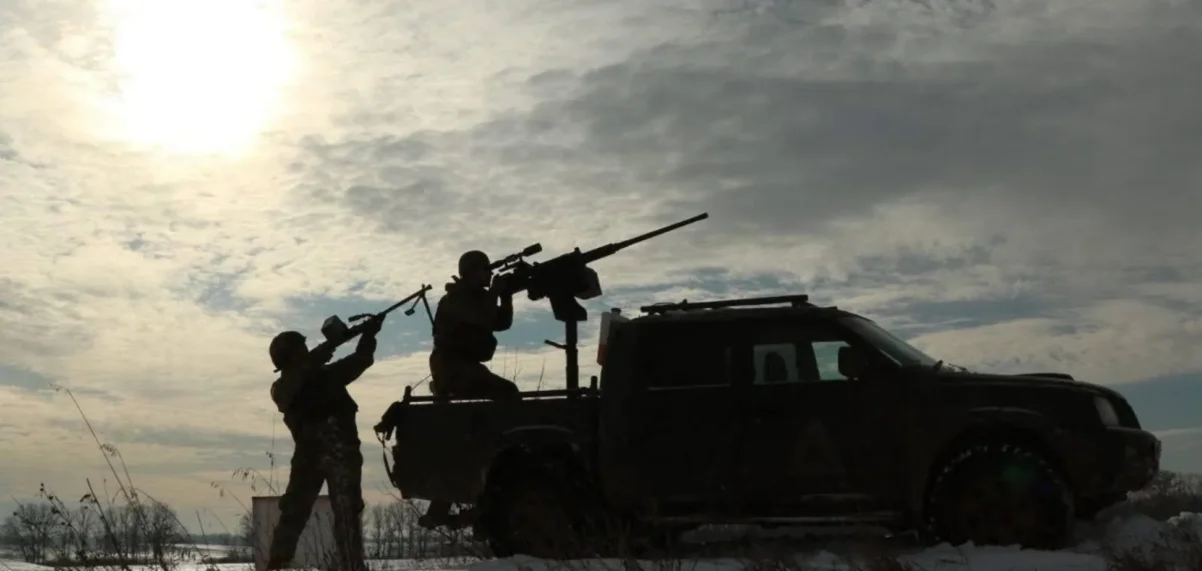
The financial side also matters here. Companies can choose protection tools depending on their needs and capabilities: from heavy machine guns to interceptor drones, turrets, and specialized solutions. For some enterprises, strengthened duty shifts and fire groups may be enough; for others, a more complex system of several layers is needed. In this sense, private air defense works as a flexible tool that can be adapted to a specific facility. The training of such units also does not look formal. Cadets train on simulators, practice scenarios of “Shahed” attacks, learn to work with aerial targets, and train drone interceptions. A separate area is the training of pilots of interceptor drones. This is complex work, because the operator must quickly assess the trajectory, speed, and maneuver of the target, and correctly approach for interception.
In terms of personnel, the system relies mainly on people with combat experience. These may be veterans, demobilized servicemen, or civilian employees who have the relevant skills and have undergone training. A representative of private air defense must have a deferment from mobilization or be demobilized. It is separately emphasized that participation in such groups does not provide automatic reservation from mobilization. That means the project should not turn into a way to avoid service, but remains a defense function for those who can legally perform it. The participation of private security companies opens another direction. Such companies, if they have a license, the relevant powers, and an order from the Ministry of Defense, can help large enterprises organize protection. This is especially important for businesses that do not have their own trained people or cannot quickly create a unit from scratch.
The strongest side of this model is the speed of scaling. The state cannot instantly cover all vulnerable facilities with additional air defense forces. A business that has resources and a direct interest in protecting its enterprises can take on part of the local tasks. If the system works through military coordination, this strengthens defense without chaos in management. The first results already have practical significance. According to the Ministry of Defense, in April private air defense shot down a jet-powered “Shahed” for the first time at a speed of more than 400 km/h. This is an important indicator, because Russian aerial attacks are changing: drones are becoming faster, routes more complex, and the burden on state air defense greater. Ukraine is forced to look for solutions that can be deployed quickly, locally, and on a large scale. At the same time, risks remain. The effectiveness of private air defense depends on discipline, the quality of training, technical equipment, and strict interaction with the military. If even one of these elements weakens, the system loses its advantage. Mistakes in air defense can cost a great deal, so the private status of units must not mean lower requirements.


For Ukraine, this model may become one of the ways to adapt to a long drone war. It does not replace state air defense, does not remove responsibility from military command, and does not give businesses a separate right to war. Its role is different: to create an additional protective layer where enterprises have already become targets, and where every downed drone means preserved jobs, logistics, production, and infrastructure. Private air defense shows how war changes the very approach to security. Business can no longer be only an object of protection. In some cases, it becomes a participant in defense controlled, trained, and included in the overall system. This is what will determine whether the new project becomes an effective tool or remains a limited initiative for individual companies.
About the Author

Related posts:
 How Ukrainian Business Supports Defense: “Tasty for Drones!” and the New Standard of Corporate Responsibility
  “Ukrainian Helicopters”: How a Private Company Profited from State Military Aircraft for Two Decades
  Fake Attacks on Business: How Ukrainian Companies Can Protect Their Reputation
  Ukraine Launches Historic Public-Private Partnership at Chornomorsk Port: What It Means and Why It Matters