Strikes on Russia’s Oil Infrastructure Are Reshaping the War: Tuapse Reveals the Cost of Energy Vulnerability
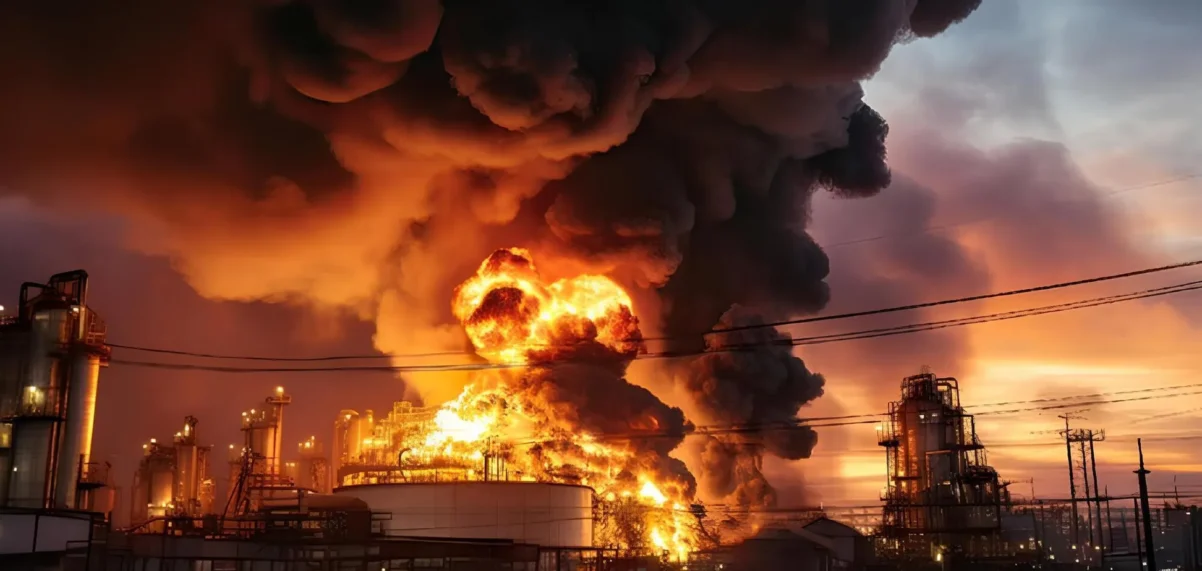
A series of strikes on the oil refinery and oil terminal in Tuapse has become more than another episode of a war far from the front line. It exposed a deeper issue Russia’s energy infrastructure is vulnerable, local authorities are unprepared for the consequences of such attacks, and environmental damage quickly turns into social tension. After the strikes on April 16 and 20, large-scale fires broke out in the Tuapse area. Smoke and smog spread for hundreds of kilometers, combustion products filled the air, an oil slick appeared in the sea, and the city itself was hit by so-called “black rain.” Vehicles, windows, laundry, and open surfaces were covered with greasy black droplets resembling fuel oil. For local residents, this was not a distant headline, but daily reality: the smell of burning oil, eye irritation, nausea, queues at pharmacies, and a lack of clear instructions.
“Time for Action” analyzed the situation in Tuapse and the broader impact of strikes on Russia’s oil infrastructure. The main conclusion is clear: Ukrainian strikes on refineries, terminals, pumping stations, and logistics hubs are no longer merely tactical episodes. They are increasingly functioning as strategic pressure on Russia’s economy, military logistics, and the Kremlin’s ability to conceal the consequences of war from its own population.
In Tuapse, the environmental situation deteriorated sharply after fires at facilities linked to oil and petroleum products. Russian authorities recorded levels of benzene, xylene, and soot exceeding permissible limits by two to three times. Only after that were residents advised not to open windows and to limit time outdoors. For many, these warnings came too late. They had already seen black residue on cars, clothes, windowsills, and streets, felt the smog, and did not understand how dangerous the air actually was.
Public frustration was driven not only by the fire itself, but also by the authorities’ response. No state of emergency was declared, schools remained open, children were not provided with masks or respirators, and residents received no clear guidance. Against this backdrop, a symbolic episode drew particular attention: on April 22, the local prosecutor’s office organized a tree-planting event and published photos of officials standing against columns of black smoke. The post was later deleted, but it had already spread widely on social media as a stark contrast between official messaging and reality. This episode matters beyond its optics. It reflects a pattern in how the system reacts: if a problem can be downplayed or contained in the public narrative, it is not fully acknowledged. When the consequences become too visible, the response is delayed, and inaction becomes evident. For civilians, this translates into a simple reality: they are left alone with smoke, uncertain health risks, and officials unwilling to openly assess the scale of the situation.
Tuapse also demonstrates that this is not just a local failure. Similar fires at oil and petrochemical facilities have occurred in other regions, including Ust-Luga, Bashkortostan, and Tatarstan. Facilities burned for days, pointing to broader issues in preparedness and response. If strategically important sites lack sufficient fire suppression systems, specialized equipment, and tested emergency protocols, each new strike risks turning into prolonged fires, environmental damage, and halted production. A war that the Kremlin sought to keep distant from everyday life is increasingly returning through attacks on energy infrastructure. For Russian citizens, this is no longer abstract reporting. It is black residue on their belongings, the smell of burning oil in their cities, worsening health conditions, concern for children, and a growing sense that authorities are not fully informing them about real risks. Another dimension is economic. Strikes on oil facilities affect one of the central pillars of the Russian state. Oil production, refining, export terminals, logistics networks, and pipelines generate revenue, supply fuel for the domestic market, and sustain the war effort. When not only refineries but also storage facilities, export terminals, pumping stations, and transport links are hit, the consequences extend beyond individual sites.
Industry estimates suggest that in April, Russia’s oil production may decline by 300,000 to 400,000 barrels per day compared to March. If confirmed, this would be the largest single drop since the pandemic. The reason lies not only in damaged facilities, but in the interconnected nature of the system. Disruptions in processing, storage, shipment, or transport inevitably affect production levels. This is why such strikes carry strategic weight. They are not limited to temporarily damaging a single installation. Their impact lies in targeting bottlenecks: logistics, storage, export capacity, rail infrastructure, pipelines, and pumping stations. These elements are harder to replace quickly, and their disruption can slow or halt multiple processes at once. The Tuapse refinery holds particular importance due to its output, especially diesel fuel. Diesel is critical for military operations: vehicles, logistics, transportation, and supply chains. Strikes on such facilities therefore affect not only export revenues, but also the ability of the Russian military to sustain operations. The method of attack also matters. Increasingly, strikes are carried out in waves. When a second strike follows before damage from the first has been repaired, recovery becomes significantly more difficult. In Tuapse, this sequence amplified the impact: damage from the first strike remained when the next hit occurred, increasing downtime, the scale of fires, and pressure on the system.
Another factor is sanctions. The European Union has imposed restrictions on 12 Russian refineries, including the Tuapse facility. Combined with drone strikes, this creates dual pressure. Sanctions limit access to technology, components, financing, and international cooperation. Strikes physically damage infrastructure. Together, these factors make recovery slower, more expensive, and less predictable.
Against this backdrop, Russia’s decision to halt the transit of Kazakh oil to Germany starting May 1 appears less technical than presented. It can be interpreted as a political signal and an attempt to pressure Berlin to influence Kyiv regarding strikes on Russian oil infrastructure. Russia cannot instantly shut down all supply routes to Europe due to long-term contracts, including those with Slovakia and Hungary, but it can use selected channels as political leverage. The situation around the “Gorky” pumping station adds to the picture. Preliminary reports indicate that three oil storage tanks were damaged and a fire covered around 20,000 square meters. This station is a key part of Russia’s oil transport system and is linked to flows that feed pipelines such as Druzhba. This shows that attacks are targeting not only refining, but also the transport backbone of oil exports. For Ukraine, this approach follows a clear logic. Russia’s oil infrastructure finances the war, provides fuel, and supports logistics. Reducing its efficiency means weakening military capability. That is why strikes are systematically directed at facilities that play a role in sustaining Russia’s war effort.
At the same time, the consequences for Russian civilians are becoming more visible. This creates a dilemma for the Kremlin. On one hand, authorities seek to avoid acknowledging the vulnerability of energy infrastructure. On the other, it is increasingly difficult to conceal black smoke, smog, oil spills, and “black rain.” People see that the war is no longer distant – it is reaching cities through economic disruption, environmental damage, and everyday insecurity. What makes this especially challenging for the authorities is the erosion of a long-standing narrative. The war was presented as something that would not significantly disrupt normal life. But when strategic facilities burn for days, when smog reaches cities like Sochi, Goryachy Klyuch, and Stavropol, and when residents begin asking whether it is safe to breathe, that narrative weakens.


Tuapse illustrates how a single strike can generate multiple layers of impact. It damages infrastructure, disrupts the oil sector, creates environmental harm, exposes administrative unpreparedness, fuels social dissatisfaction, and demonstrates that Russia’s systems are less protected than portrayed. What matters here is not only that oil infrastructure is burning. What matters is that along with it, the idea of a safe distance between war and domestic life in Russia is also collapsing. The Kremlin continues its war against Ukraine, but its consequences are increasingly returning to Russian cities through fires, smog, production disruptions, export challenges, and growing public concern. If the frequency of such strikes increases, pressure on Russia’s oil and gas sector will intensify. Sanctions, physical damage, logistical disruptions, and environmental consequences may reinforce each other. The question will then extend beyond how many facilities Russia can repair, to whether it can maintain stability in a system that simultaneously funds the war, sustains exports, and supports the domestic market.
About the Author

Related posts:
 Energy Strikes on Ukraine, Emergency Blackouts and the Belgorod Attack
  Fuel Crisis in Russia: Why Moscow Turns to Belarus for Supplies as Refineries Halt and Regions Impose Limits
  Frozen Russian Assets: A New Stage of Western Pressure to Support Ukraine
  Power Outages in Autumn 2025: How the Energy Sector Changes Under the Pressure of Attacks