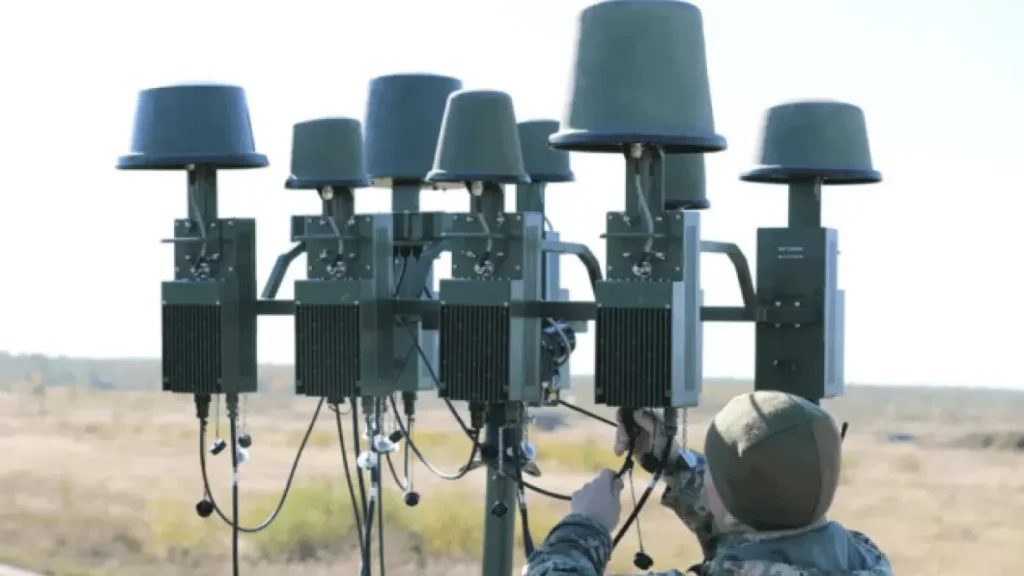
Electronic Warfare: How EW Affects Drones, Navigation, and Modern War
In modern war, missiles, tanks, artillery, and drones usually remain the most visible. But a significant part of combat operations today depends on what cannot be seen with the naked eye radio signals, navigation, communication channels, video transmission, and control of equipment. Drones do not exist separately from the radio spectrum. An FPV aircraft needs a control channel between the operator and the unmanned aerial vehicle, a video signal in the opposite direction, telemetry, and often satellite navigation. If one of these elements is disrupted, the drone may lose accuracy, controllability, or the ability to complete its mission at all. This is why electronic warfare has become one of the key areas of war. It does not always physically destroy equipment, but it can make it useless at a specific moment: deprive the operator of an image, disrupt the route, spoof coordinates, or break control. Time for Action examined how EW works, why modern drones have become the main target for electronic influence, and why the effectiveness of such systems increasingly depends not only on power, but also on speed of analysis, precision, and coordination.
What EW Is and Why It Has Become Critically Important
Electronic warfare is a set of technical tools and actions aimed at detecting, protecting, disrupting, or spoofing the operation of the enemy’s electronic systems. This concerns communications, navigation, radars, weapons control systems, unmanned systems, and data transmission channels. For civilians, this can be explained through familiar examples. Wi-Fi, Bluetooth, mobile communications, and GPS work thanks to signals. If a signal is weak, jammed by interference, or spoofed, the device begins to work incorrectly: the internet disappears, headphones lose connection, and the map shows a false location. In war, the consequences are much more serious. If a drone loses a stable signal, the operator may not see the target, may be unable to control the aircraft, or may receive incorrect coordinates. In such a situation, even a technically functioning drone may lose combat effectiveness. This is why navigation sometimes works incorrectly in cities during air attacks. This may be the result of systems that jam or spoof the navigation signal in order to divert enemy drones from their route.
A Drone as a System Dependent on Several Signals at Once
A modern unmanned aerial vehicle is not only a body, motors, a camera, and a battery. Its operation depends on several channels that must function simultaneously. A typical drone uses:
- a control channel;
- a video transmission channel;
- satellite navigation;
- telemetry;
- communication between the aircraft and the operator.
The control channel is needed to transmit commands from the remote control to the drone. The video channel gives the operator an image from the camera. Telemetry transmits data on the state of the aircraft, altitude, speed, charge, position, and other parameters. Navigation allows the drone to understand where it is. If one of these elements is disrupted, the mission may be derailed. For FPV drones, this is especially critical because they are often controlled in real time. The operator must see the image, assess the trajectory, adjust the flight, and accurately guide the aircraft to the target. Without stable communication, FPV loses its main advantage precise manual control.
EW Does Not Always Have to Down a Drone. Often It Is Enough to Disrupt Its Mission
A common mistake is to believe that effective EW must necessarily make a drone fall immediately. In reality, the main result may be different. EW can:
- deprive the drone of communication with the operator;
- degrade the video image;
- create a delay in image transmission;
- make navigation inaccurate;
- spoof coordinates;
- force the aircraft to deviate from its route;
- prevent the operator from completing the attack;
- force the drone to switch to emergency mode.
In combat conditions, this is enough. If an attack FPV does not see the target or loses guidance accuracy, its effectiveness drops sharply. If a reconnaissance drone cannot transmit quality video or correct coordinates, its mission also loses meaning. Therefore, EW is not only about the physical destruction of equipment. It is about control over the electronic environment in which this equipment operates.
The Three Main Mechanisms of EW: Jamming, Interception, and Deception
Electronic warfare works through several main approaches.
Jamming
Jamming is the creation of radio interference that blocks or suppresses the enemy’s signal. If a system transmits powerful interference on the frequency where a drone’s control channel or navigation operates, the necessary signal may simply “drown” in noise.
In the case of FPV, this may mean loss of control. In the case of a video channel loss of the image. In the case of navigation the inability to correctly determine location.
Interception
Interception concerns the detection and analysis of signals. Here it is important to distinguish between electronic intelligence and electronic warfare Electronic intelligence detects, receives, and analyzes signals. It can help understand which frequencies the enemy uses, where the source of the signal is approximately located, and what type of equipment is operating in the spectrum. Electronic warfare already affects these signals: it jams, distorts, or spoofs them.In modern systems, these functions can work together. First, the system sees the signal, determines its type or frequency, and then helps choose a response method.
Deception
Deception consists of falsifying signals. This is not about simply “jamming” a drone, but about making it receive incorrect data. The best-known example is GPS spoofing. In this case, the drone receives not a real navigation signal, but a fake one. If the false signal is stronger or more convincing for the receiver, the aircraft may begin to believe that it is in another place. This can lead to deviation from the route, a positioning error, emergency landing, or mission failure.
White Noise and Smart EW: The Difference Between Brute Force and Precision
In EW systems, two different approaches to signal suppression can be distinguished. The first is classic “white noise.” The system creates interference across a wide frequency range. The necessary signal is lost among radio noise. This method is relatively simple, but it has a significant drawback: it is less selective and can interfere not only with the enemy, but also with friendly systems nearby. The second approach is smart EW. Such a system first analyzes the electronic environment: which signals are present in the spectrum, on which frequencies they operate, and what type they may belong to. Only after that is interference applied precisely against a specific signal or threat scenario. This is important because the modern front is oversaturated with radio signals. Friendly and enemy drones, control consoles, video channels, radios, navigation, reconnaissance systems, and other technical tools operate simultaneously. In such conditions, simply “flooding everything with noise” is no longer enough. It can harm friendly units. Therefore, the effectiveness of EW increasingly depends on precision, adaptability, and the ability to quickly understand what exactly is happening in the spectrum.
Why Frequency Warfare Changes So Quickly
One of the main difficulties of EW is the constant change of frequencies. If the enemy understands that a certain range is being effectively jammed, they switch to other frequencies. Previously, a significant share of FPV drones operated on typical control ranges, particularly 868/915 MHz. When portable anti-drone systems began to be widely used against such threats, the enemy began shifting to non-standard frequencies. At first, the 700–800 MHz ranges were used. Then 400–500 MHz. Later, cases of unmanned aerial vehicles being controlled at frequencies below 400 MHz, as well as above 1.2 GHz, began to be recorded. Video channels are changing in parallel. From the usual analog 5.8 GHz, some solutions are shifting to 2.4 GHz or 1.2–1.3 GHz. This means that EW cannot be a static system with one set of settings. If a tool cannot quickly update parameters, scan the spectrum, and respond to new frequencies, its effectiveness decreases.
Frequency Hopping Makes the Work of Ordinary Suppression Tools More Difficult
In addition to changing frequencies, pseudo-random frequency hopping is used. In this mode, the drone and the control console synchronously “jump” across different frequency channels dozens of times per second. For ordinary static interference, this is a difficult target. If the system jams one frequency, the signal may already have moved to another. Therefore, more complex solutions are needed that can quickly detect patterns, track activity, and respond to changes in the radio environment. This moves EW from the plane of simple power to the plane of system intelligence. What matters is not only how strong the transmitter is, but also how quickly the system can understand where exactly the threat is operating.
What Happens to an FPV Drone Under EW Influence
The behavior of a drone depends on which channel EW affects. If the influence is directed at the control channel, the operator may lose the ability to transmit commands. For FPV, this is critical because the aircraft is controlled in real time. In such a case, the drone may begin to fly unstably, lose accuracy, leave its trajectory, hover, descend, fall, or execute a pre-programmed scenario. If the influence targets the video channel, the operator loses their “eyes.” The image may disappear, freeze, break up, lag, or become too poor for precise guidance. For an attack FPV, this often means a loss of effectiveness. If EW affects navigation, the drone may incorrectly determine its location, lose its route, or deviate from the set trajectory. Not every drone immediately falls under the influence of EW. Some models have safe return or hover modes. But under active electronic influence, these mechanisms may also fail. Then the aircraft loses control, falls, or makes an emergency landing.
GPS Spoofing as a Way to Make a Drone Make a Mistake
GPS spoofing is one of the most illustrative examples of electronic deception. Its task is not to turn off navigation, but to replace it. A drone often navigates using satellite signals. If an EW system creates false GPS signals that are stronger than the real ones, the drone’s receiver may accept them as genuine. As a result, the aircraft sees false coordinates. For a drone, this may mean movement along a false trajectory, loss of route, or emergency landing. For the operator, this creates a situation in which the equipment formally continues to work, but its navigation logic is already disrupted. This differs from jamming. During jamming, the signal is suppressed or disappears. During spoofing, the drone receives a signal, but that signal is false.
Why EW Can Interfere With Friendly Drones
One of the most difficult problems at the front is coordinating EW systems with friendly unmanned aircraft and communication systems. If interference is created without planning, it may affect not only enemy equipment, but also Ukrainian drones. Therefore, effective EW work requires coordination between units. Several approaches are used for this. The first is frequency separation. Units must agree in advance on which frequencies friendly pilots operate on and which frequencies will be suppressed. The second is time windows. When a friendly drone is operating, EW systems in a certain area may be temporarily switched off or their mode changed. After the flight is completed, suppression is activated again. The third is sector-based operation. Instead of omnidirectional antennas, directional antennas are used, emitting interference in a narrow sector toward the enemy. This allows a cleaner spectrum to remain in the rear, from where friendly operators work. These methods show that EW is not only about technology. It is also about planning, discipline, interaction, and rapid communication between units.
Why Portable Tools Are Often No Longer Enough
At the beginning of the full-scale war, portable anti-drone tools were in very high demand. There were fewer threats, drone-use scenarios were simpler, and frequency solutions were more predictable. Over time, the situation changed. The number of unmanned aerial vehicles increased, attacks became more massive, frequencies became more diverse, and the drones themselves became more adaptive. In such conditions, one portable tool often cannot cover the full spectrum of threats. Systems are needed that work more broadly, more precisely, and more intelligently: scanning the spectrum, detecting anomalies, changing settings, working in conjunction with intelligence and other protective tools. The effectiveness of modern EW can no longer be measured only by the number of kilowatts. Reaction speed, quality of analysis, the ability to work with different ranges, and flexible updating become important.
The Role of Artificial Intelligence in EW
Artificial intelligence and machine learning are increasingly being used to analyze the large volumes of data generated by electronic warfare and intelligence systems. In the modern radio spectrum, many signal sources operate simultaneously: drones, control consoles, communication systems, video transmission, navigation, and other electronic tools. It is difficult for a person to quickly process such a volume of information manually. AI-assisted EW systems can help:
- find patterns;
- classify signals;
- distinguish typical patterns;
- detect changes in the spectrum;
- identify signals resembling drone activity;
- prompt the operator on what to pay attention to;
- speed up decision-making.
But it is important not to exaggerate the capabilities of AI. It is not an autonomous “magic button” that wins the battle in the radio spectrum by itself. Effective work requires quality data, model training, result verification, proper integration into the system, and an operator who understands the combat situation. The most realistic role of AI is not to replace a person, but to strengthen their work. The system processes large data arrays faster, while the final decision is made by a human.
Why There Are Many Expectations and Myths Around AI and Drones
The topic of artificial intelligence in military technologies is often accompanied by exaggerations. Media and cultural products sometimes show drones that supposedly unite into swarms fully autonomously, independently recognize targets, and act almost without human involvement. In practice, such solutions are much more complex. Experiments with drone swarms are being conducted around the world, but full-fledged combat use of this approach as a stable concept still remains limited. Similarly, compact form factor, flight duration, accuracy of autonomous recognition, and real resistance to EW remain difficult technical tasks. This does not mean that such technologies are impossible. But there is a great distance between a demonstration idea and stable combat application. War quickly tests any technology for practicality: whether it works under interference, lack of time, unstable communications, limited resources, and constant enemy counteraction.


Ukraine as a Platform for the Development of EW Technologies
During the full-scale war, Ukraine has become one of the world’s largest platforms for the development and testing of electronic warfare technologies in real combat conditions. This is connected with the scale of drone use, the speed of tactical changes, the enemy’s constant frequency adaptation, and the need to protect military personnel, equipment, and critical infrastructure. A number of manufacturers are already operating in the Ukrainian sector, creating electronic warfare tools, electronic intelligence systems, and smart systems for detecting and suppressing unmanned aerial vehicles. Some of these solutions are used to protect personnel, equipment, facilities, and combat units. Some manufacturers already have significant production volumes, and some Ukrainian solutions are receiving opportunities for testing abroad. This indicates that EW has become not only a military need, but also a separate technological direction of Ukraine’s defence industry.
Electronic warfare has become an invisible but critically important front of modern war. It affects whether a drone can reach its target, whether the operator will see the image, whether navigation will work correctly, and whether the aircraft will remain controllable. Modern EW is no longer only a matter of a powerful transmitter. It is a struggle for speed of analysis, precision of influence, adaptation to new frequencies, coordination between units, and the ability to work in an oversaturated radio spectrum. The main goal of EW is not necessarily to physically down a drone. Often it is enough to make it fail its mission: lose its route, accuracy, image, control, or trust in its own navigation. For Ukraine, the development of such technologies has strategic significance. The mass use of drones has made electronic warfare one of the decisive elements in protecting the military, equipment, cities, and critical infrastructure. And the faster drones, frequencies, and enemy tactics change, the greater the role becomes of systems capable not merely of jamming, but of seeing, analyzing, adapting, and acting precisely.
About the Author

Related posts:
 The Invisible Becomes Visible: How Chinese Scientists Are Rewriting the Rules of Long-Distance Imaging
  Starlink under control: how the “white list” reshaped communications at the front and in the rear
  An Autumn That Will Decide the Future: What NATO Really Expects on Ukraine’s Front Line
  Electronic Money Today and CBDC: What the Fundamental Difference Is