Associated EU Membership for Ukraine: Why Merz’s Proposal Sparked Criticism in Kyiv
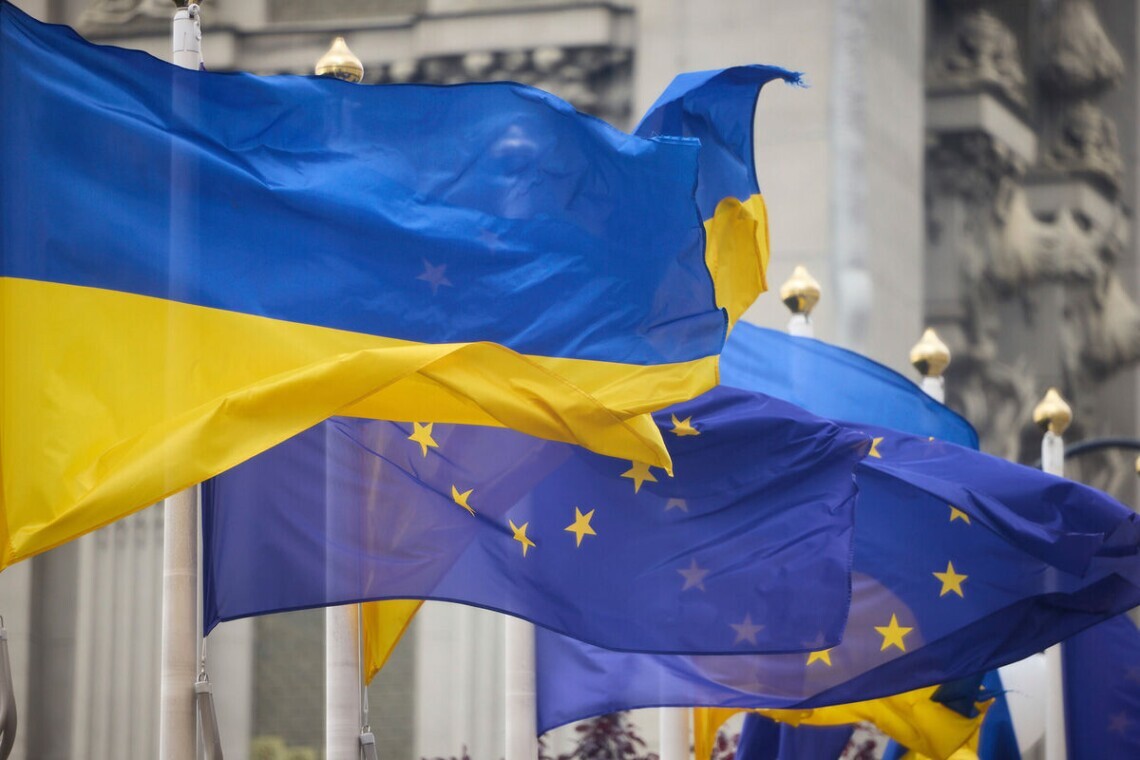
German Chancellor Friedrich Merz’s proposal on “associated membership” for Ukraine in the European Union without full voting rights immediately triggered a sharp reaction in Kyiv. For the Ukrainian authorities, any intermediate format sounds risky: after years of war, the fulfillment of European integration requirements, and political expectations in society, it may be perceived as an attempt to replace full membership with a more convenient option for the EU.
At the same time, this proposal is not a direct refusal of Ukraine’s accession to the European Union. Time for Action analyzed the issue: Merz’s idea rather shows that the EU is looking for a way to bring Ukraine closer to European institutions faster than the standard accession procedure allows. The problem is that this search is taking place in a very sensitive area, where every formulation carries political weight for Kyiv. Merz proposed immediately opening all negotiation clusters for Ukraine if Kyiv has already fulfilled the relevant conditions. It also concerns Ukraine’s actual presence in EU institutions: Ukrainian members of the European Parliament, a European commissioner, participation in summits of EU leaders, but without voting rights. In other words, Ukraine could gain wider access to the political life of the EU even before full accession.
It was the absence of voting rights that became the most painful point of this idea. For Ukraine, the issue of EU membership has long ceased to be only a diplomatic procedure. It is connected to war, security, losses, political identity, and a sense of justice. Therefore, President Volodymyr Zelensky’s reaction was predictable: he emphasized that Ukraine’s presence in the EU must be full and equal. The position of Foreign Minister Andrii Sybiha was softer, but also cautious. He positively assessed the search for options itself, but warned that no intermediate models can replace full membership. This is an important signal: Kyiv does not reject the idea of practical rapprochement with the EU, but does not want a temporary mechanism to turn into a political ceiling.
Ukraine’s main fear is understandable. An intermediate status can become a trap if it is not clearly established that this is only a stage on the path to full membership. In European politics, temporary decisions sometimes live for years. For Ukraine, which is counting on the irreversibility of its European course, such a risk is serious.
However, Merz’s proposal did not emerge out of nowhere. Earlier, Kyiv supported the idea of so-called “reverse membership,” under which Ukraine would first receive EU membership, and only then gradually expand access to the single market, provided there was constant progress in democratization and the rule of law. But this option did not gain support among a significant part of the member states.
France and Germany were the first to oppose the idea of “reverse membership.” They were supported by Austria, Belgium, Bulgaria, Greece, Hungary, the Netherlands, Poland, Slovakia, and Sweden. Instead, two other approaches gained more chances: preserving the current situation or gradually integrating Ukraine into the EU. Merz’s proposal is close to the second option.
German analyst Roland Freudenstein drew attention to an important detail: Merz’s plan does not differ from the Ukrainian idea of “reverse membership” as much as it may seem at first glance. In both cases, it is about Ukraine’s partial integration into the EU before all complicated procedures are completed. The difference lies in the sequence and scope of political rights. The Ukrainian option would provide more political weight immediately. The German option offers presence in European structures, but without the full right to influence decisions. For Kyiv, this is a fundamental difference. For some European capitals, it is a way to give Ukraine visible movement forward without immediately opening all the political and economic consequences of full accession.
The key problem is timing. Expectations have been voiced in Ukraine that the state could become an EU member in 2027 or 2030. In Brussels, such timelines are viewed much more cautiously. Freudenstein directly notes that in Berlin, Brussels, and even Warsaw, there is an understanding that Ukraine’s accession to the EU in the next few years is currently unrealistic. The reasons do not come down only to the reluctance of individual leaders. Ukraine’s full membership in the EU would mean a deep change of the Union itself. It concerns difficult ratification in member states, the distribution of influence inside the EU, access to the single market, agricultural policy, the services market, the rule of law, the fight against corruption, and the readiness of the European Union itself to accept a large country that is at war.
That is why the EU is looking for intermediate models. For Brussels, they can reduce part of the political tension and show Ukraine that the process is not standing still. For Kyiv, they carry both an opportunity and a danger. The opportunity lies in faster integration into European institutions. The danger lies in losing a clear prospect of full membership. The security element of the proposal deserves separate attention. Freudenstein noted that Merz’s option could provide security guarantees under Article 42.7 of the Treaty on European Union, which concerns mutual assistance between EU states. For Ukraine, this could have practical weight if such a mechanism is not a declaration, but a real agreed political decision.
At the same time, even the presence of such an element does not remove the main question will “associated membership” be a step toward the EU, or a convenient substitute for full accession? This should be at the center of Ukraine’s diplomatic position. The problem is not the very fact of an intermediate format, but the absence of guarantees that it will not become a long-term limitation.
Lana Zerkal also called for not perceiving Berlin’s proposal only as an attempt to block Ukraine’s accession. Her assessment is important because it draws attention to the real complexity of the process. Full accession to the EU depends not only on Ukraine’s decisions or Brussels’ goodwill. It passes through political procedures, national ratifications, and the internal fears of member states. Therefore, Kyiv’s reaction must combine principle and cool calculation. Ukraine must insist on full membership as the final goal, but at the same time work carefully with all intermediate models that can provide real advantages right now. Rejecting any partial format without detailed analysis may work against Ukraine if the EU is still not ready for rapid full accession.


Merz’s proposal shows an uncomfortable but important reality Ukraine’s European path is supported, but most member states are not ready for immediate full enlargement. This does not mean that accession is being canceled. It means that the coming years may pass in the search for new forms of integration that will give Ukraine more participation, more security, and more practical rapprochement with the EU. For Ukraine, the main thing is not to allow the formula of “partial presence” to turn into a political waiting zone without an end date. Any associated or intermediate membership must be clearly formalized as a stage toward full accession, and not as a compromise that removes the EU’s responsibility for future enlargement. This is the main challenge. Ukraine needs to accept the reality of a complicated European process, but not agree to a blurred perspective. The EU, for its part, must prove that intermediate models are not a way to postpone the decision, but an attempt to bring Ukraine closer to a full place in the Union. Otherwise, even the most “innovative solutions” risk looking not like a step forward, but like a new form of political waiting.
About the Author

Related posts:
 Trump, Merz and U.S. Troops in Germany: Why the Dispute Over Iran Became a Question of European Security
  Ukraine and the EU: 26 Leaders Say Yes, While One Says No
  Elections and Peace Talks: How Ukraine’s Political Landscape is Changing
  Ukraine’s Digital Integration into the EU as a Test of State Readiness