A Truce Without Peace: Why the Pause Between the United States and Iran Already Looks Fragile
The truce between the United States and Iran, agreed upon with Pakistan’s mediation, appears at first glance to be a quick diplomatic success. It briefly reassured markets, pushed oil prices down, and allowed global leaders to speak about a chance for de-escalation. But this assessment holds only on the surface. A closer look at the parameters of the agreement reveals something else: the core contradictions were not resolved, only postponed for a few days. This makes the current pause look less like the beginning of a stable settlement and more like an interval between two phases of the crisis.
Chas dlya Diy analyzed why this truce appears fragile from the outset, which issues are already generating tension ahead of the upcoming talks in Islamabad, and why the logic of the agreement itself points not to the end of the conflict, but to a struggle over the rules that will follow it.
Formally, the sides agreed to a two-week ceasefire. It is important that this arrangement was directly tied to Iran reopening the Strait of Hormuz. This condition alone shows that the deal is not just about a military pause, but about redistributing control over one of the most critical nodes of global trade. For decades, the Strait of Hormuz was treated as a route that, despite geopolitical risks, operated under relatively clear international norms: navigation was to remain free, and transit was not to be subject to unilateral fees by coastal states. That assumption is now being challenged. The most dangerous aspect of the current situation is that it is not about a temporary disruption, but about an attempt to redefine how the route functions. If the framework of the truce indeed allows Iran and Oman to impose transit fees, this signals the emergence of a new mechanism of influence that extends far beyond the war itself. In such a case, Iran would gain not just a tactical lever, but a long-term economic tool affecting the entire region. This is where the first major contradiction emerges. It may seem intuitive that global consumers would ultimately bear the cost of new fees through higher prices. In reality, the primary burden falls on the Gulf states themselves. They are the ones exporting large volumes of oil and gas through the strait, and therefore they are the ones who would lose part of their revenue on every shipment. For global markets, the effect may be diluted. For Riyadh, Abu Dhabi, or Kuwait, it would mean a постоянное снижение экспортной маржи. The same logic applies to other goods such as fertilizers, petrochemicals, and related products. In effect, countries that have already absorbed losses from the war risk indirectly financing part of Iran’s post-war strategy.
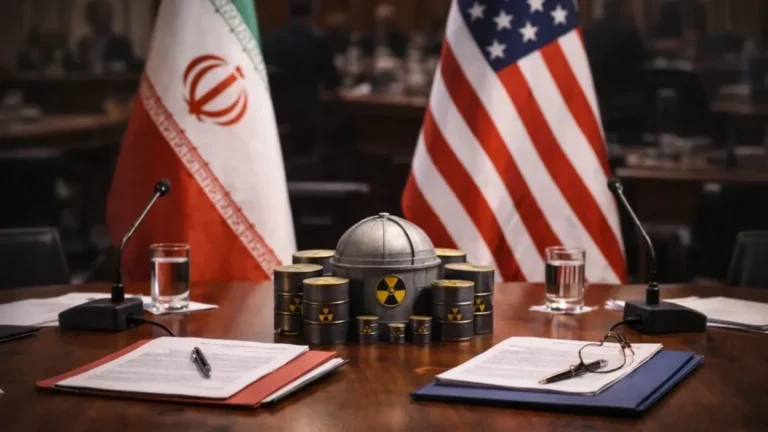
This shift has implications not only for economics but for regional politics. If before the war the Strait of Hormuz functioned as a critical global artery, after the truce it may evolve into a tool of selective access. Reports about a system in which “friendly” countries receive more favorable passage conditions, while routes are regulated through permits and approvals, suggest the emergence of a politicized transit regime. This is no longer about maritime safety. It is about political alignment. In this model, Iran converts military vulnerability into economic leverage. Even without achieving a conventional victory, it seeks to secure a mechanism that will outlast the ceasefire. The second major contradiction concerns Iran’s nuclear program. It highlights just how unstable the current compromise is. Public signals from both sides do not align even on basic formulations. The Persian-language version refers to recognition of enrichment or agreement on its level. At the same time, the American side insists that there should be no enrichment at all. This is not a minor wording difference. It reflects fundamentally incompatible end goals.
For the United States, the demand for “no enrichment” is an attempt to eliminate Iran’s ability to retain nuclear capacity as a political asset. For Tehran, the issue goes far beyond technical limits. It is tied to sovereignty, bargaining power, and internal legitimacy. Under such conditions, abandoning accumulated capabilities within the framework of a short-term truce appears highly unlikely. What makes the issue even more critical is that it is not theoretical. There are already substantial stockpiles of uranium enriched to high levels. This cannot be postponed indefinitely through vague diplomatic language. It requires a clear answer: whether Iran will give up these reserves, agree to their removal, or dilute them under international supervision. That is precisely why this issue has effectively been moved outside the immediate scope of the truce. Both sides understand that it could collapse the agreement before it even begins to function. But postponement is not resolution. It simply transfers the most sensitive conflict into the negotiation phase, where both sides will arrive with mutually exclusive positions. The third source of instability is Lebanon. Here, the problem lies not only in ongoing military activity, but in fundamentally different interpretations of the truce itself. The Israeli position assumes that the agreement does not apply to Lebanon, where operations against Hezbollah continue. The mediator presents a different understanding. This discrepancy is dangerous precisely because it is not technical. For Iran, Lebanon is not peripheral. It is part of its regional influence structure. Continued strikes there can be interpreted not as a separate conflict, but as a direct undermining of the ceasefire.
In such a framework, each side operates with its own definition of what is acceptable. The United States, and likely Israel, may view the pause as limited to direct confrontation. Iran may argue that pressure on its regional allies contradicts the logic of de-escalation. This creates a highly unstable arrangement in which even without a formal violation, each side can accuse the other of breaking the agreement. All of this points to a central conclusion: the current truce lacks a shared interpretation. That is always a sign of a weak agreement. A durable ceasefire requires at least a minimal consensus on what exactly is being halted, what actions are permitted, what is prohibited, and what constitutes a breach. None of that is clearly defined here. What exists instead is a temporary pause tied to several major issues, each of which is capable of collapsing it on its own.

There is also a broader implication for the international system. Iran has demonstrated that even a mid-sized state, unable to win a conventional war, can impose significant economic pressure on the global system. This pressure was sufficient to force negotiations under altered conditions. This does not mean Iran achieved a traditional victory. The costs it faced were substantial. But it does indicate something else: asymmetric warfare has once again proven its strategic effectiveness. This matters beyond the Middle East. If a state can leverage control over a narrow trade chokepoint to compel major powers to discuss new rules, fees, and compromises, it sends a signal to others. It is not necessary to replicate the Iranian scenario exactly. It is enough to understand the principle: military dominance does not automatically guarantee control over economic outcomes. And when the guarantor of global order cannot quickly restore pre-war conditions, that order begins to appear less stable. This leads to the most uncomfortable conclusion. The truce does not restore the region to its pre-war state. On the contrary, it may formalize a new reality in which Iran emerges militarily weakened but economically empowered as a source of pressure. The United States gains a pause, but not clarity on the nuclear issue, not stability in Lebanon, and not a full restoration of free navigation through the Strait of Hormuz. The key question is no longer whether the fighting has been paused for two weeks. The question is whether the sides share even a minimal vision of what peace would look like afterward. At this stage, the answer appears negative. The Strait of Hormuz, uranium, and Lebanon are not secondary elements of the truce. They are its core, simply deferred in time. And these very issues will determine whether the current agreement evolves into a lasting settlement or turns out to be just a short break before the next phase of confrontation, with even higher stakes.
About the Author

Related posts:
 Trump’s Force-First Course on Iran What’s Behind the Strikes
  Oil Under War Pressure How the Conflict Around Iran Is Changing Global Prices and What It Means for Ukrainian Drivers
  Bitcoin Amid the Death of Iran’s Leader How a Geopolitical Shock Shook the Crypto Market
  Bitcoin and War in the Middle East: Why Crypto Reacts First and Where It Leads