Usyk vs Verhoeven: Why the WBC Title Fight in Egypt Goes Beyond a Standard Defense
Time for Action looked into why Oleksandr Usyk’s fight against Rico Verhoeven is an event that goes beyond a typical championship defense. Formally, it is a title bout for the WBC belt in the heavyweight division. In practice, it is a meeting point of sport, promoter interests, and the trend toward “hybrid” matchups, where the ring features stars not only from boxing.
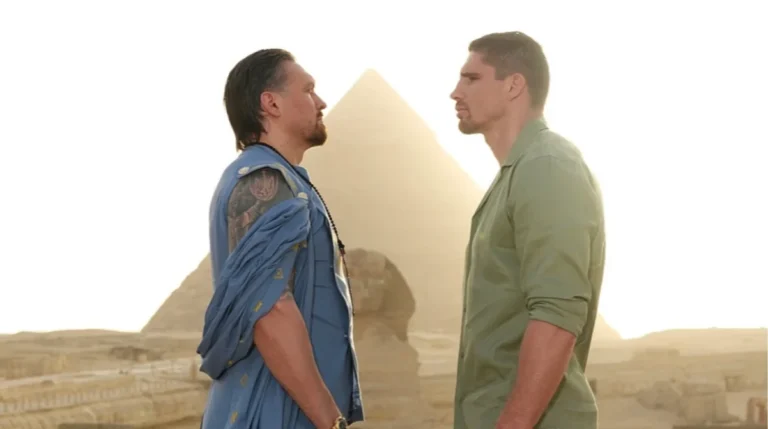
On May 23, Oleksandr Usyk is set to fight in Egypt, in Giza, against Dutchman Rico Verhoeven. Only the WBC heavyweight title held by Usyk will be on the line. The bout was announced by Turki Alalshikh, head of Saudi Arabia’s General Entertainment Authority.
For Usyk, this is an unusual sporting situation: the opponent is not a professional boxer from the boxing rankings system, but a long-time kickboxing champion. Verhoeven, despite being a superstar in his sport, has only one bout under boxing rules (in 2014).
Who Rico Verhoeven Is and What He Brings Into This Fight
Rico Verhoeven is a 36-year-old Dutch kickboxer who has competed professionally since 2004. His main credential is a long championship run in GLORY: a title held since 2014, 13 title defenses described as a record, and at the end of 2025 the belt was vacated.
Verhoeven’s profile includes what promoters readily “translate” into boxing: endurance and the ability to sustain a high pace. In March 2024, he fought three times in one night in a Grand Prix and won all three bouts. His most recently cited kickboxing fight was in June 2025 against Russian Artem Vakhitov, a judges’ decision win.
Verhoeven also appeared in media scenarios as a possible opponent for Anthony Joshua, but that option was dropped after a fatal car crash in which the British boxer’s trainers were killed.
For the fight against Usyk, the key point is different: Verhoeven is an elite fighter, but he was not part of the real boxing rotation in the heavyweight division. He brings scale and reputation to the bill, but he does not bring what usually underpins title defenses in boxing ranking logic.
How This Fight Entered Usyk’s Plans
The sequence looks like a series of attempts to find the next major bout after another peak.
Usyk last fought in July 2025, when he beat Daniel Dubois in a unification fight and became the undisputed world champion for the second time in his career. After that, he vacated the WBO belt. He still holds the WBA, WBC, and IBF titles.
At the same time, different options appeared on the horizon:
- a WBO defense against Fabio Wardley, which did not happen because Usyk declined and vacated the title;
- an idea of an MMA-rules fight against Jake Paul, with no deal reached;
- a scenario involving Deontay Wilder, whom Usyk challenged, but the fight did not materialize, and Wilder ended up facing Derek Chisora.
In early February, Turki Alalshikh publicly said he wanted to see Usyk vs Verhoeven. Eventually, the WBC allowed a voluntary defense with an important condition: the next bout must be a mandatory defense, with German Agit Kabayel as the leading contender.
This means the Verhoeven fight did not “replace” a mandatory challenger, but it was slotted in ahead of it as an interim yet high-profile stop.
Why This Fight Goes Beyond Classic Sport
In recent years, boxing has increasingly blended the sporting product with show, especially in the heavyweight division. The return of big names, celebrity bouts, and experiments with participants from other disciplines have become part of the market. Heavyweight was one of the main stages for this format: former UFC champion Francis Ngannou fought Tyson Fury and Anthony Joshua, creating a precedent where a “non-boxer” faces boxing’s elite.
The specific feature of Usyk vs Verhoeven is that a championship belt is at stake, not just an exhibition status. That raises the perceived stakes. At the same time, boxing rules “consume” part of the intrigue. In early February, Verhoeven proposed a mixed-rules format: one round of boxing, one round of kickboxing. But that was abandoned because Usyk’s belt is on the line.
The venue is another signal that the event is designed as a global-scale spectacle. Giza, the pyramids, the dedicated poster styling this is not a random location choice, but a way to sell the fight as a “historic night.”
What This Fight Means for Usyk
Usyk enters the bout as a champion who remains undefeated: 24 wins, 15 by knockout; in the heavyweight division, eight wins. In boxing terms, that gives him a clear advantage: round rhythm, footwork, distance management, timing, championship-level experience, and the ability to “read” an opponent in pure boxing.
But there is another dimension reputational. For a champion of this level, any opponent choice becomes a point of evaluation: whether it is movement within the division, or a market decision. If the fight looks one-sided, it will be perceived as a controlled defense and a demonstration of the gap between sports. If the bout turns tense, criticism may not target technique, but the decision to choose this kind of defense.
One more important point: after this fight, attention will inevitably return to the mandatory challenger. WBC conditions lock that in. So this defense has not only media value, but also time constraints it cannot turn into a series of shows without consequences for the title line.
What This Fight Means for Verhoeven
For Verhoeven, this is a rare chance even for the most successful kickboxing champions: to enter the center of the boxing world not through an exhibition, but through a title night against a champion. The sporting risk is high, but the career risk is manageable: even a loss will not “erase” his kickboxing legacy, while his name becomes more recognizable.
His positioning in public statements is built as a story of hunger for new challenges. That works for the poster, but it also highlights the difference: he is stepping into a discipline that is not his own.
Usyk vs Verhoeven is a title defense built according to the rules of the modern promoter-driven market. It delivers scale, exotic visuals, and an easy-to-sell narrative of “the absolute in one sport against the absolute in another.” But it also raises the question of balance between the sporting logic of the division and a champion’s media decisions.
For Usyk, this night is a test not only of form, but of how he manages status and time in the heavyweight division. For Verhoeven, it is an attempt to prove that a kickboxing champion can be competitive in boxing even when the rules work against him.
About the Author

Related posts:
 Usyk Requests Delay of WBO Title Fight Against Parker: Injury Report and What Happens Next
  Oleksandr Usyk Granted Right to Voluntary WBC Title Defense: Who Will Be the Champion’s Next Opponent?
  Oleksandr Usyk and the Voluntary Title Defence: What the WBC Decision Really Means
  Oleksandr Usyk’s Last Opponent: Who Will Face the Undisputed Champion in His Farewell Fight?