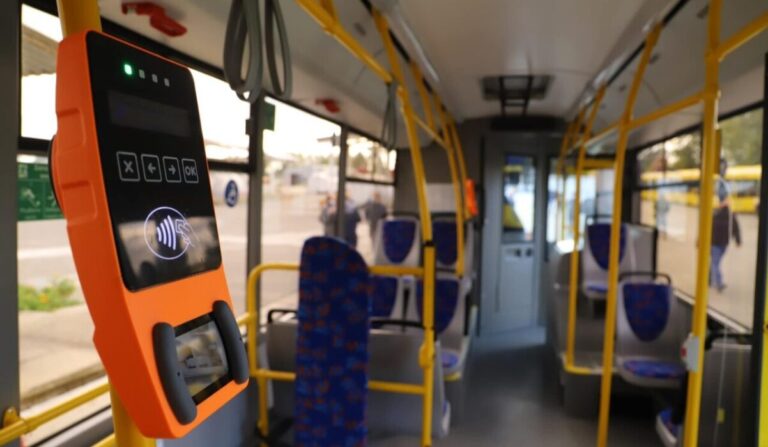
Kyiv Public Transport Fare at UAH 30: How the New Tariff May Hit Workers and the Labor Market
Plans to raise the cost of travel in Kyiv’s municipal transport to UAH 30 per trip may have much broader consequences than it may seem at first glance. This is not only a question of the city budget, transport cost price or a new tariff scale. For part of Kyiv residents and people living in the suburbs, the road to work may turn into a separate expense item that will take away a noticeable part of their salary. Time for Action examined the issue: the potential fare increase will affect people with low incomes the most, especially those who cannot work remotely and depend on public transport every day. This concerns workers in education, medicine, retail, security, municipal services, cultural institutions, support staff and many other specialists without whom the city cannot function normally.
Currently, travel in the capital’s municipal transport costs UAH 8. The proposed model provides for a tariff of up to UAH 30 per trip if 1 to 9 trips are purchased on a transport card. With larger packages, the price will gradually decrease: UAH 28.90, UAH 27.80, UAH 26.60, UAH 25.50 and UAH 25 per trip when purchasing 50 trips. Monthly passes are expected to give a cost of one trip of approximately UAH 23.3-23.6, while an unlimited monthly pass may cost UAH 4,875.
For people with medium and high incomes, this is also a noticeable increase. But for workers with salaries of UAH 12-18 thousand, such a change may become critical. According to vacancies in Kyiv, cleaners are offered an average of UAH 18,000, state enforcement officers UAH 17,000, teacher assistants and orderlies UAH 15,000, watchmen UAH 12,600. These are the categories for whom even several hundred hryvnias of additional monthly expenses matter.
If a person travels to work and back without transfers, at a fare of UAH 30 they will spend UAH 60 per day. For 20 working days, this is UAH 1,200 per month. For a worker with a salary of UAH 12,000, this is about 10% of income only for the road. If one more transfer is added, the daily amount may rise to UAH 120, and the monthly amount to UAH 2,400. For a resident of Troieshchyna who travels by trolleybus and metro there and back, exactly this amount becomes a realistic calculation.
At this point, transport stops being just a city service and begins to influence a person’s decision on where to work.A worker is already calculating not the nominal salary, but how much will remain after transport, utility bills, food and basic expenses. If traveling across the whole city takes away a significant part of income, a job near home may become more profitable even with a lower position or a change of professional direction.
This may hit low-paid sectors especially hard, where there is already a shortage of people. Education, medicine, security, retail, cleaning, household and support services depend on workers who must physically be on site. A teacher, orderly, cashier, security guard, librarian or dishwasher cannot do their work from home. If the road becomes too expensive, some people will start looking for work closer to home, moving into related fields or leaving vacancies that require daily travel.
A separate risk concerns suburban residents. In recent months, intercity minibuses to Kyiv have become more expensive. A trip from Brovary to the capital already costs UAH 50, from Sofiivska Borshchahivka UAH 50, from Irpin UAH 80, from Boryspil UAH 100-130. If trips by city transport inside Kyiv are added to this, transport costs may rise to a level that for some workers becomes incompatible with their salary.
For employers, this means new pressure. If it becomes unprofitable for employees to travel to work, companies will have to respond. One option is to raise salaries. Another is to pay for travel passes or introduce a transport allowance. Another is to organize employee transportation. In retail chains, the practice of selecting a store closer to the candidate’s place of residence is already common, so that a person does not spend extra money and time on the road. After the fare increase, this approach may become even more important.
Not all employers are ready to take these costs upon themselves voluntarily. Some companies may consider transport to be the employee’s personal problem. But such a position works only as long as there are enough people willing to work under the offered conditions. If vacancies begin to remain open longer, and people refuse because of the commute, businesses will still have to look for solutions.
The rise in travel costs may not be the only reason for changing jobs, but it can become the final argument for those who are already dissatisfied with working conditions, salary, management or the absence of income review. In such cases, additional transport expenses will only speed up the decision to leave.
There is also a broader economic effect. If employees demand compensation, and employers raise salaries or cover travel costs, these expenses may gradually move into the prices of goods and services. Financial analyst Andrii Shevchyshyn also draws attention to possible additional inflationary pressure. According to his estimate, this increase alone could add about 1.6% to inflation, taking into account the share of transport services and Kyiv’s influence on the overall indicator.
The problem is also that the proposed cost of the pass looks very high compared with many European cities. An unlimited monthly pass for UAH 4,875 may turn out to be more expensive than in a number of European capitals, including Vienna, Prague, Budapest or Warsaw. At the same time, the income level of Kyiv residents differs significantly from the income of residents of many European cities, so a direct comparison of tariffs without taking salaries into account distorts the picture of affordability.


Transport in a large city is not an additional convenience, but a basic condition for access to work, education, medicine and services. If travel becomes too expensive, the city begins to lose mobility. People narrow the geography of their job search, employers face staff shortages, and low-paid sectors receive another blow to stability.
The situation remains open. New tariffs are planned to be introduced after regulatory policy procedures, consultations with the public and trade unions. At the same time, alternative options are being voiced: a compromise maximum of UAH 20 or a justified minimum of UAH 15. A petition calling to stop the tariff increase until the end of martial law quickly gathered the required number of votes for consideration, which shows the level of public tension.
Private carriers are not yet planning to raise minibus fares and are waiting for final decisions from the city authorities. But if municipal transport becomes sharply more expensive, the risk of price revision in the private sector will not disappear, especially if the cost of transportation or demand changes.
Raising the fare to UAH 30 may become for Kyiv not just a transport decision, but a socio-economic test. It will test not only the solvency of passengers, but also employers’ readiness to support workers, the city’s ability to take into account people with low incomes and the real role of public transport in the capital’s economy. If these factors are ignored, Kyiv risks getting not only more expensive travel, but also a stronger staff shortage where people are already needed every day.
About the Author