Martial law in Ukraine and anti-corruption reforms: what the new laws mean for society, business, and the EU path
On July 15, 2025, the Verkhovna Rada of Ukraine once again made a decision that has become routine over the past three years to extend martial law and general mobilization for another 90 days, from August 7 to November 5, 2025. 320 deputies voted for bill No. 13471, and 304 for No. 13472 on mobilization. President Volodymyr Zelensky signed both laws on the same day, and they have already come into force.
“This is already the sixteenth extension of martial law since February 24, 2022,” reminded MP Iryna Herashchenko (“European Solidarity”).
The reasons for this decision remain unchanged: Russian aggression, constant danger to the state, the need for maximum mobilization of resources and people. Each extension is not just a formality, but a legal fixation that the country continues to live under a special regime with restrictions on rights and freedoms.
Main consequences for citizens and business:
- All restrictions related to martial law remain in force: curfew, the possibility of restricting gatherings, document checks, requisition of property, etc.
- Those liable for military service must be ready for conscription; all mobilization norms remain in effect.
- For business and the economy: uncertainty persists, legal and financial risks increase, and planning remains difficult.
The Anti-Corruption Crisis: The Independence of NABU Under Threat
On July 22, the Verkhovna Rada adopted a law that effectively gives the Prosecutor General, appointed by the President, control over NABU and SAP the country’s key anti-corruption agencies. President Volodymyr Zelensky signed the law, which sparked a sharp reaction in society, among experts, and Western partners.
“This pressure campaign is a direct reaction to the effectiveness of our investigations, especially those concerning high-ranking officials and members of parliament. This decision puts at risk not only the work of anti-corruption agencies, but also Ukraine’s Euro-Atlantic aspirations,” said NABU director Semen Kryvonos.
What are the risks?
- The independence of NABU and SAP is in question: the leadership could find itself under political control.
- A real threat to European integration: an independent anti-corruption system is a key requirement for Ukraine’s accession to the EU.
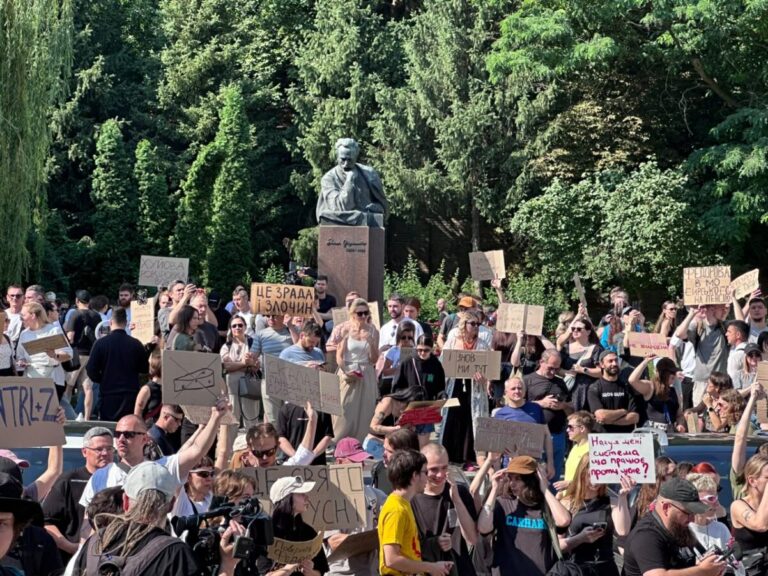
- Public distrust: immediately after the law was signed, hundreds of people protested in Kyiv and other cities.

Rollback and New Bill: An Attempt to Restore Balance
The response to pressure from society and the EU was immediate. Already on July 24, Volodymyr Zelensky approved the text of a new bill No. 13533, which aims to restore all procedural powers and guarantees of independence for NABU and SAP.
“NABU and SAP participated in preparing the text and call on the Verkhovna Rada to promptly adopt the President’s initiative. This will help prevent threats to criminal proceedings investigated by NABU and SAP,” said a joint statement by the anti-corruption agencies.
The European Commission openly welcomed this initiative, emphasizing that the independence of the anti-corruption system is not just an internal matter for Ukraine, but a key element of the European integration strategy.
“We expect all candidate countries, including Ukraine, to fully comply with these standards,” emphasized the spokesperson of the European Commission.
Legislative “Swings” and Systemic Consequences
This story once again shows that Ukrainian legislation is subject to both internal political games and the pressure of Western partners. Any attempt to weaken anti-corruption institutions immediately sparks protest both outside and inside the country. This is both evidence of the maturity of civil society and confirmation that the fight against corruption remains a battleground for fierce confrontation.
- For Ukrainians, it is important not to lose vigilance: even during war, the quality of governance and institutions determines the country’s future.
- For business: trust in the state depends directly on the predictability of legislation and the real independence of regulatory agencies.
- For international partners: real independence of NABU is a criterion for providing assistance, loans, and support for EU integration.
Ukraine has once again proven that it stands at the crossroads of external challenges and internal risks. The extension of martial law is an expected measure, but it keeps the country in a state of tension and mobilization. The anti-corruption crisis has become a litmus test not only for state institutions, but for society as a whole.
Genuine transparency, independence, and dialogue are not only “European requirements” but also a condition for maintaining trust and hope for change. Every law, every initiative is a test of the country’s and its government’s maturity. And this test is ongoing right now.
About the Author

Related posts:
 An Assault on Anti-Corruption Independence in Ukraine: What Draft Law No. 12414 Means
  Ukraine at a Crossroads: Why the II Anti-Corruption Forum of the UBA Matters
  Debt Without Delay: What Draft Law No. 9363 Really Means for Ukraine
  The U.S. May Cut Funding for War Crimes Investigations: What This Means for Ukraine