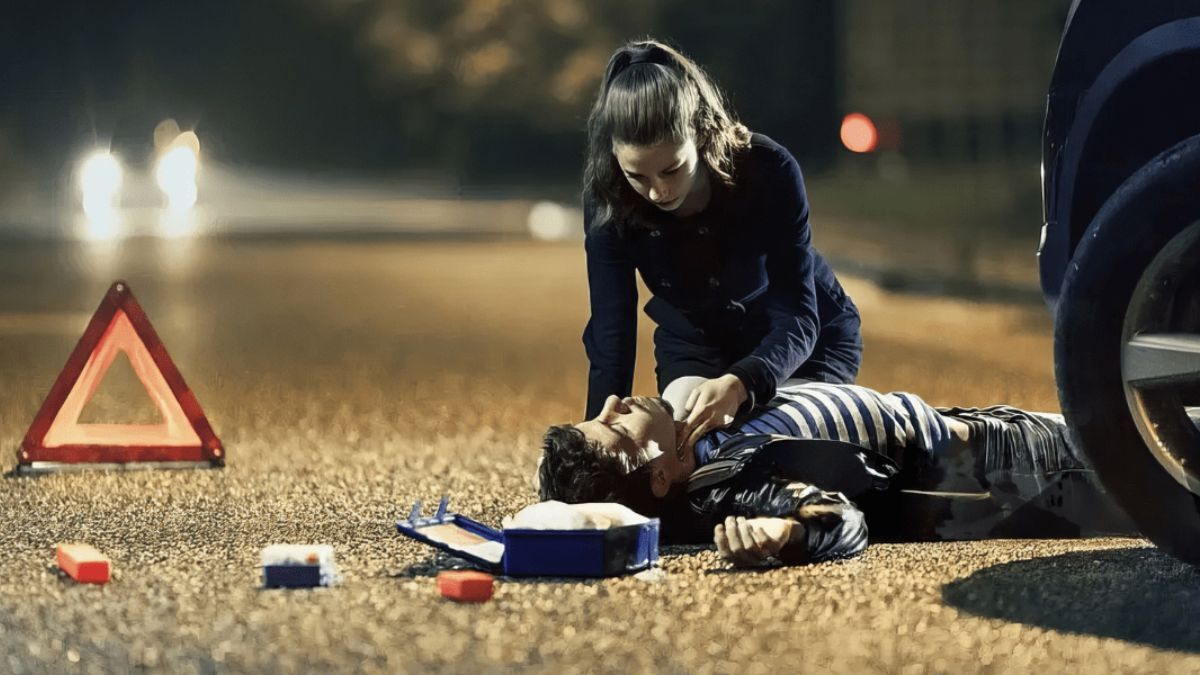
Witnessing a Road Accident: First Aid Instructions from Ukraine’s Ministry of Health
Time for Action analyzed the action algorithm recommended by the Ministry of Health in cases where a person becomes a witness to a road traffic accident. This is not about complex medical procedures, but about basic steps that can determine whether an injured person has a chance to survive until emergency services arrive.
Reduced street lighting, disabled traffic lights, and difficult weather conditions all increase risks on the road. But another factor remains critical: how witnesses behave during the first minutes after a crash. This short window of time often becomes decisive. The first step is the safety of the person providing help. The recommendation is clear:
“Before providing assistance, make sure there is no danger to yourself.”
This is not a formality. A person in emotional shock may rush toward the injured without noticing a burning vehicle, leaking fuel, or active traffic. Assistance should not create another victim. If there is no threat, the next step is to call emergency medical services at 103. It is important to do this immediately, even if the situation seems under control. Specialists emphasize that every minute matters. Next comes contact with the injured person.
“Approach the injured person and loudly ask a simple question, for example: ‘Can you hear me?’”
This is more than a question. It is the primary assessment of consciousness. If the person responds, it means they are conscious and their airway is open. In such a situation, it is important not to leave them alone, to explain that help has already been called, and to provide verbal support. Psychological and emotional state at the moment of trauma plays a significant role: fear and disorientation intensify physical pain. When the injured person is conscious, it is necessary to ask what is bothering them at that moment. This helps assess the nature of the injuries and prepare information for medical personnel. A different situation arises when the person has lost consciousness. Here the algorithm becomes more structured and decisive.
“If a person has lost consciousness, the following must be done: – check vital signs, breathing, and the presence of critical bleeding; – if critical bleeding is present, it must be stopped immediately; – if there is no breathing, begin cardiopulmonary resuscitation; – if the injured person is unconscious but shows signs of life, place them in a stable position and wait for medical personnel to arrive.”
This algorithm is built on a fundamental principle of emergency care: first address breathing and circulation. The Ministry of Health emphasizes:
“Most deaths of road accident victims occur due to bleeding and airway obstruction.”
This means primary attention must focus precisely on these factors. Critical bleeding can lead to death within minutes. Airway obstruction poses an equally immediate threat. Special attention should be given to the stable position. If a person is unconscious but breathing, they should be carefully placed on their side to prevent airway blockage or aspiration. This simple action can save a life. Preventing heat loss is also essential. Trauma and shock are often accompanied by a rapid drop in body temperature. Therefore, the recommendation is logical:
“Until the emergency medical team arrives, avoid heat loss cover the injured person with a thermal blanket or a regular blanket.”
Hypothermia worsens blood clotting and overall physiological stability. Even in warm weather, an injured person can quickly lose body heat. An important emphasis is placed on acting within one’s competence.
“Provide assessment and assistance only when you are confident in your actions. It is important not to harm the injured person.”
This is a professionally balanced position. Attempting complex manipulations without proper knowledge can cause additional injuries, including spinal damage. If the injured person’s condition deteriorates, the algorithm предусматриes a repeated call to emergency services. This matters because dispatchers can provide further instructions by phone.


A separate block of recommendations concerns prevention. The use of reflective elements, especially in the dark, significantly reduces the risk of being struck by a vehicle. A pedestrian wearing dark clothing on an unlit road is nearly invisible to drivers. In poor weather conditions, this danger multiplies.
From a therapeutic perspective, the most important aspect of this algorithm is not only technique but psychological readiness to act. A person witnessing a crash often experiences shock or paralysis. A clear sequence of steps helps structure behavior and reduce panic. First aid is not heroism and does not require medical education. It is the ability to remain calm, assess the situation, and carry out basic actions. These actions create a bridge between the moment of injury and the arrival of professional responders. In critical situations, simple things become decisive: safety, calling for help, checking breathing, stopping bleeding, maintaining warmth, and monitoring the condition. Everything beyond that belongs to medical professionals.
About the Author

Related posts:
 New Rules After an Accident: How Motor Insurance Works with Direct Settlement
  Road Funding in Ukraine in 2026: Budget Cuts, Debt, and Infrastructure Risks
  Direct settlement of MTPL as a new norm for drivers and insurers
  Night Attack on Kyiv: How “Shahed” Drones Use Shrapnel and What You Must Know to Stay Safe