The New “Inverted” U.S. Food Pyramid: who presented it, what exactly changed, and why it matters
On January 7, 2026, the United States released the Dietary Guidelines for Americans 2025-2030 the core federal nutrition document updated every five years. Its influence goes far beyond public communication, shaping school meals, military nutrition, and federal assistance programs.
This edition was publicly presented by U.S. Secretary of Health and Human Services Robert F. Kennedy Jr. and U.S. Secretary of Agriculture Brooke Rollins. Alongside the document, a new visual symbol appeared The New Pyramid, which quickly became the most debated element.
Why this caused such a strong reaction
Because this was not just a design change. Any food pyramid is a visual hierarchy, and people interpret it very literally: what is bigger and higher is more important, what is smaller and lower is secondary.
In the new model:
- the strongest emphasis is placed on protein, dairy & healthy fats;
- the middle layer consists of vegetables & fruits;
- the smallest share is given to whole grains.
Because of this structure, many called it an “official turn toward a low-carb approach”. But this interpretation requires nuance.
Why the visual model caused more reaction than the document itself
A food pyramid is not neutral infographics. It shapes an intuitive sense of “what is right.” What is placed higher and occupies more space is perceived as the foundation. What is lower and smaller is perceived as secondary.
In the new version:
- protein, dairy products and fats are placed at the top;
- vegetables and fruits are in the center;
- grains are at the bottom and in a much smaller proportion than before.
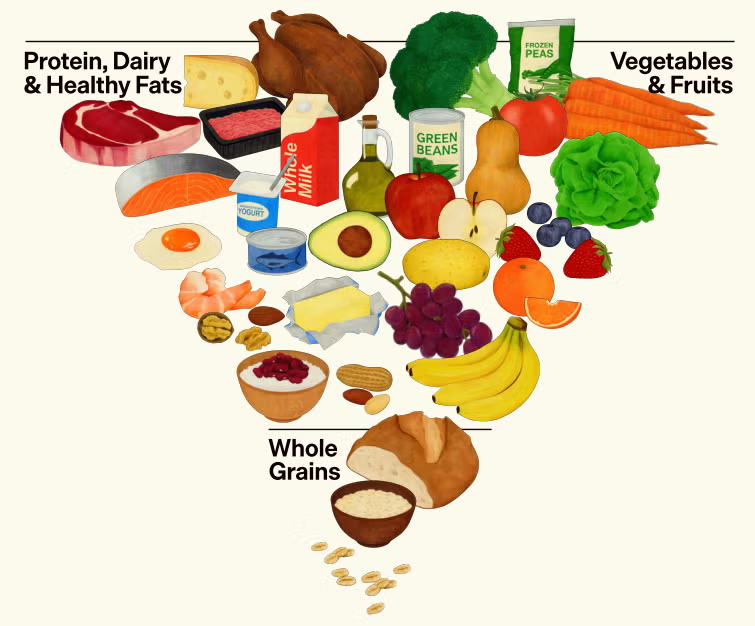
This is exactly what triggered a wave of interpretations about an “official turn toward keto” or a “war on carbohydrates.” The problem is that the pyramid started being read without the text, while the new recommendations are fundamentally not reducible to a single image.
How it was before and why that model stopped working
For previous decades, the logic of MyPlate dominated in the United States an even distribution of the plate between vegetables, fruits, grains and protein. In theory, the model looked balanced. In practice, it:
- did not account for different levels of physical activity;
- ignored age-related changes;
- reduced health to calories and proportions.
The baseline protein norm of 0.8 g per kilogram of body weight effectively meant a minimum sufficient for survival, but not for:
- maintaining muscle mass;
- recovery after illness;
- prevention of sarcopenia;
- metabolic stability.
The new recommendations emerged as a response to these weaknesses.
Protein as a foundation, not a supplement
One of the key changes is raising the recommended protein intake to 1.2–1.6 g per kilogram of body weight per day. This is not a random number and not a concession to fashionable diets.
The logic here is multi-layered:
- protein has a higher thermic effect and provides better satiety;
- it is critical for muscle mass, which is directly linked to lifespan and quality of life;
- protein deficiency is often masked as “normal eating.”
At the same time, the document does not reduce protein to meat. It explicitly states that:
- legumes,
- soy,
- nuts,
- seeds
are also complete protein sources.
The method of preparation is no less important: baking, stewing and stir-fry are emphasized over deep frying, which sharply degrades nutritional quality.
Fats: from bans to structure
Another important shift is the abandonment of fat demonization. But this does not mean “eat any fats without limits.”
The recommendations clearly distinguish:
- unsaturated fats as the daily foundation;
- saturated fats as a limited category, not exceeding 10% of total daily calories.
Saturated fats explicitly include palm and coconut oil, lard, beef fat, butter, ghee, meat and dairy products. In other words, the issue is not a single product but a systemic imbalance.
The practical logic is simple and realistic: salads and heat treatment plant oils; dishes like porridge and mashed potatoes a bit of butter; animal fats a backup option, not the base.
Dairy products without fear or extremes
One of the unexpected elements is that the recommendations bring back full-fat dairy products. Low-fat options are no longer presented as automatically “healthier.”
Dairy is positioned as:
- a source of protein,
- beneficial fats,
- calcium and trace minerals.
The guideline is up to 3 servings per day within a standard diet. A popular myth that “dairy is unnecessary for adults” is also explicitly challenged.
Vegetables and fruits: a stable base without idealization
There is no revolution here, but there are important clarifications. Priority is given to:
- whole foods without added sugar;
- frozen and canned options without sugar as a normal alternative.
The recommendations remain clear:
- 3 servings of vegetables per day;
- 2 servings of fruit per day.
The role of fiber, the microbiome and fermented foods is emphasized as part of modern health understanding.
Grains: not an enemy, but no longer the foundation
Grains are not removed from the diet. The emphasis has shifted:
- whole grains yes;
- refined and ultra-processed minimize.
The guideline of 2–4 servings per day shows that carbohydrates remain part of nutrition, but no longer define its structure.
Added sugars: the strictest and most controversial block
The document states its position without softening: added sugars are not recommended. A limit is introduced up to 10 g of added sugar per meal.
This point has generated the most criticism because it:
- is difficult to follow in real life;
- can increase food-related anxiety;
- carries a risk of orthorexic patterns when followed literally.
In essence, this is an example of how good intentions require competent explanation, not blind execution.
Sodium and alcohol: no half-tones
The recommendations refer specifically to sodium, with clear age-based limits. The main focus is not on salt itself but on its hidden sources in ultra-processed foods.
Regarding alcohol, the position is as direct as possible: there is no safe dose, and the recommendation is to reduce consumption.
Special groups and the move away from “one diet for everyone”
Separate sections are dedicated to:
- people with chronic diseases,
- pregnant women and breastfeeding women,
- children of different ages,
- older adults,
- vegetarians and vegans.
This marks a fundamental shift away from universal advice toward individualized approaches and the role of specialists.
The core meaning of the new pyramid
The new model is not about extremes. It is about:
- reducing ultra-processed food;
- increasing nutrient density;
- moving away from calorie obsession;
- focusing on REAL FOOD food that is close to natural.
The main value is understanding the recommendations as a whole, rather than searching for confirmation of existing beliefs.
Nutritionist’s Conclusion: what the new pyramid really means and how to read it without extremes
If we set aside emotions, loud headlines, and the clash of camps on social media, the new inverted food pyramid is not about a revolution, but about the maturing of the approach to nutrition. It does not call for eating mountains of meat, it does not cancel vegetables, and it does not declare war on carbohydrates. Instead, it tries to address real problems modern people face: protein deficiency, excess ultra-processed food, chronic fatigue, unstable appetite, and metabolic disruptions.
The core message is very simple, even if it feels unfamiliar to many:
– food quality matters more than calorie counting.
– nutrient density matters more than perfect plate proportions.
Raising protein targets is not a trend or a dogma, but a response to age-related muscle loss and sedentary lifestyles. Bringing fats back into the diet is not permission for uncontrolled consumption, but an attempt to move away from decades of fear around them. Reducing the role of grains is not a ban, but a signal that they no longer need to be the foundation of every meal. At the same time, the new guidelines clearly reveal their own weak points. Strict language around sugar, an emphasis on numbers without sufficient explanation, and a visual pyramid that is easy to misinterpret all of this requires context and common sense, not literal execution.
From a nutrition science perspective, the most important shift is the explicit recognition that one diet does not work for everyone. Age, health status, activity level, pregnancy, lactation, and chronic conditions all matter. No pyramid can replace an individualized approach. That is why the new model should be seen not as an instruction manual, but as a direction of movement:
- less ultra-processed food,
- more real food,
- adequate protein,
- fats without fear but with balance,
- carbohydrates that are high quality and consumed in reasonable amounts,
- less obsession with numbers, more attention to the body’s signals.
And perhaps most importantly: this pyramid is not about perfection. It is about sustainability, flexibility, and long-term health, not short-term diets or rigid “right” eating. That is how it should be read.
About the Author

Related posts:
 New Food Summit 2025: The Main Event for Those Shaping the Future of Food in Ukraine
  How to Keep Food Safe During a Blackout: Effective Methods for Ukrainian Realities
  Black Friday: How Online Shopping in Ukraine Has Changed and Why Trust Matters More Than Discounts
  Liver: Health Benefits, Types, and the Right Way to Add It to Your Diet