Berlin as a point of fixation: what actually changed in the peace negotiations after the meetings of Ukraine, the United States, and Europe
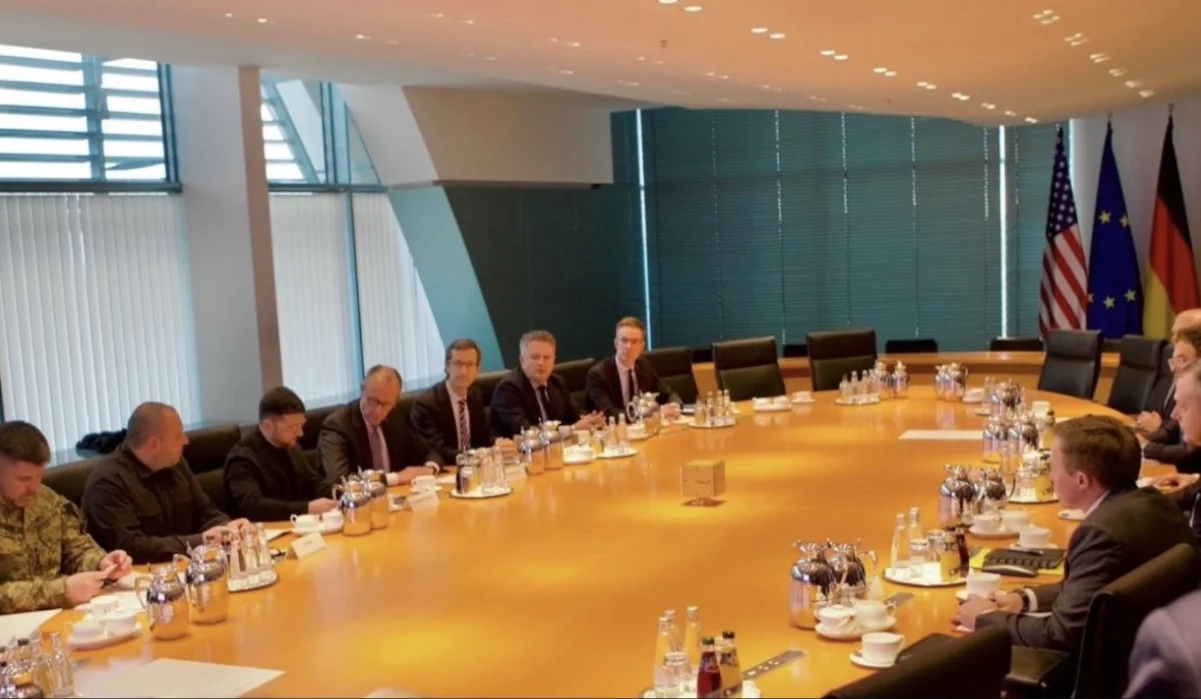
Time for Action has analyzed the outcomes of the Berlin negotiations held on December 14-15, 2025, the joint statements by President of Ukraine Volodymyr Zelenskyy and German Chancellor Friedrich Merz, as well as the broader diplomatic context into which these events are embedded. This is not about a “breakthrough” and not about a finalized peace agreement, but about an important fixation of the negotiation framework within which the parties will be forced to move forward. The public briefing in Berlin was less a summary of results and more a report on the complexity of the process. The President of Ukraine openly acknowledged the existence of disagreements on the most sensitive issue. “There are difficult issues related to territories, in order to resolve these questions fairly. We still have different positions, but I am glad that I was able to personally present my position,” Volodymyr Zelenskyy stated. This wording is important because it does not create the illusion of compromise where none exists, while at the same time fixing the fact that the Ukrainian position was conveyed directly, without intermediaries or distortions.
For his part, the German Chancellor emphasized that the day before the public briefing a confidential trilateral meeting of the United States, Ukraine, and Germany had taken place, during which the parties had already agreed on a common position reflected in the peace plan. Friedrich Merz’s key phrase outlines a new focus of the negotiations: “We all know the price of war, but the time has come to talk about the price of peace. This includes issues of security guarantees, territories, and an effective mechanism that will control the ceasefire.” In this logic, peace is presented not as an abstract goal, but as a set of concrete, costly, and politically painful decisions.
Particular attention should be paid to Zelenskyy’s public statement regarding the position of the United States. The President clearly separated the demands of partners from those of Russia. “We perceive this as a demand from Russia. I told the United States to pass this information on to the Russians,” he emphasized, speaking about the issue of the non-occupied territories of Donbas. This is a fundamental detail. Ukraine has, for the first time, so directly fixed that territorial ultimatums are not a condition coming from Washington, but remain part of Russia’s agenda. For the negotiations, this means a shift in responsibility for the deadlock: it is now more clearly localized.
Following the conclusion of the two-day talks, the allies outlined a list of security guarantees that are to be implemented after a ceasefire is achieved. All points share a common feature: they are not automatic and do not come into force without political decisions. The focus is on sustainable security, not symbolic promises. In particular, partners are prepared to support the development of Ukraine’s Armed Forces at a level of 800,000 personnel in peacetime, which is explicitly described as necessary to deter future conflicts and protect Ukraine’s territory. This figure runs through all recent negotiation formats and has effectively become a baseline compromise framework accepted by both the United States and Europe.
Another key element is the creation, under European leadership, of “multinational forces of Ukraine”, formed from volunteers from the so-called coalition of the willing with the support of the United States. Their declared role is to assist in rebuilding Ukraine’s armed forces, ensuring the security of Ukrainian airspace and sea, and supporting stability, including through actions inside Ukraine. The wording leaves room for interpretation, but it is important that this is not a classic peacekeeping mission, but rather a hybrid presence format.
Separately, a mechanism for monitoring and verifying the ceasefire under U.S. leadership with international participation and a defined deconfliction mechanism is envisaged. This signals an understanding of the main risk of any agreement: violations without consequences. This is complemented by legal obligations to respond to possible renewed Russian aggression, investments in Ukraine’s recovery, and confirmed political support for Ukraine’s accession to the European Union.
To understand the significance of the Berlin meeting, it is important to look at the previous dynamics of the negotiations. On November 20, Ukraine received a draft American peace plan that Washington considered a potential basis for revitalizing diplomacy. Its initial points were unacceptable for Kyiv: relinquishment of Donetsk, Luhansk, and Crimea, refusal to join NATO, reduction of the Armed Forces to 600,000 personnel, and elections in Ukraine within 100 days after signing such agreements. Already after consultations in Geneva on November 23, Ukraine and the United States announced changes to a number of provisions, and the United Kingdom, France, and Germany agreed on a European version of a peace plan consisting of 24 points.
Subsequent statements by Zelenskyy confirmed that the updated American plan contains 20 points, developed in Geneva and refined in Florida. On December 11, Ukraine provided the Trump administration with a step-by-step response. According to a Ukrainian official, the document contains comments and proposals that “may make the entire plan workable,” as well as new ideas on difficult issues, including territories and the status of the Zaporizhzhia Nuclear Power Plant. This formulation shows that Kyiv is not rejecting negotiations, but is attempting to change their logic, rather than simply reacting to ultimatums.
At the same time, active European diplomacy was underway. From December 8 to 14, Zelenskyy held a series of meetings with European leaders, including a summit in London with Keir Starmer, Emmanuel Macron, and Friedrich Merz, as well as a broad joint phone call with leaders of EU and NATO countries and Turkey. The main objective of these contacts was stated directly: to ensure that Europe’s voice is taken into account in all decisions.
Post List




From a political analysis perspective, the Berlin negotiations did not bring peace closer in a direct sense. But they fulfilled another, no less important function. They narrowed the field of acceptable decisions, fixed that territorial demands remain an area of conflict rather than consensus, and outlined a framework of security guarantees without which any ceasefire will not be considered stable.
The extended conclusion is that the current stage represents a phase of hard diplomatic bargaining, not the preparation of a final document. Europe is trying to secure its role as an equal participant, the United States is adjusting its initial approaches, and Ukraine is consistently defending the boundaries of possible compromises. In this game, there are no quick solutions and no “cheap peace.” And it is precisely this, despite all the complexity, that makes the Berlin statements important: they honestly show that peace is not a gesture of goodwill, but a long and costly process in which every word has consequences.
About the Author

Related posts:
 Elections and Peace Talks: How Ukraine’s Political Landscape is Changing
  Talks in Istanbul: Why the Third Round Is Not About Peace, But Messaging
  The Oval Office Map: What It Signals for Ukraine’s Talks and Security Guarantees
  War, Peace, and the Diplomacy of Ultimatums: What Lies Behind the US “Favorable Conditions” for Russia