Roads Without Money: How Funding Cuts, Debt, and War Are Reshaping Infrastructure Priorities
Time for Action analyzed the situation facing Ukraine’s road sector ahead of 2026. Data from the State Agency for Restoration and Infrastructure Development show a clear trend: funding for road repair and maintenance is being sharply reduced, while pressure on key routes is increasing due to war, frontline logistics, and evacuation needs. In 2026, compared to 2025, expenditures are planned to be cut by 40% to UAH 8.494 billion, making this figure the lowest since the start of the full-scale invasion.
Figures from previous years only underscore the scale of the decline. In 2022, UAH 14.254 billion was allocated for road repair and operational maintenance, UAH 16.795 billion in 2023, UAH 12.527 billion in 2024, and UAH 13.934 billionin 2025. Against this background, the planned UAH 8.494 billion for 2026 looks not merely like another cut, but a shift in the very logic of how the sector survives. The situation is further complicated by accumulated debts to contractors. According to the head of the State Agency for Restoration and Infrastructure Development, Serhii Sukhomlyn, outstanding payments for road maintenance amount to about UAH 12 billion. In response, the agency was forced to revise its repair approaches. In some regions, the cost of current repairs was reduced almost by half, and on average by 30–40%, resulting in over UAH 900 million in savings from road maintenance alone. However, saving resources does not resolve the core issue: how to keep the network operational amid chronic funding shortages.
Even within 2025, allocated sums were described as critically insufficient. As of September, the state budget provided UAH 12.8 billion for road maintenance, while, according to the Minister for Communities and Territories Development Oleksii Kuleba, nearly UAH 80 billion per year is needed for the normal functioning of the road sector. The gap between actual needs and available resources has become systemic and is now deepening further. Against this background, the story surrounding the road to Bukovel caused particular public resonance. In early December, a tender appeared in the Prozorro system for developing design documentation for a new road in the Carpathians along the Bystrytsia – Yablunytsia via Polyanytsia section, where the Bukovel resort is located. The total length of the potential route is 28.6 km, and media reports began circulating a figure of UAH 6.6 billion, triggering a wave of publications about an alleged large-scale road construction project funded by the state.
The State Agency for Restoration denied these claims, emphasizing that it concerned only design and cost-estimate documentation, which is a preparatory stage lasting at least a year. No funding for construction works is provided, and their execution would be possible only after the war ends. Later, Serhii Sukhomlyn clarified that the feasibility study for the road was developed by local communities using their own funds, while the regional Restoration Service announced the design tender without coordination with the agency. As a result, the head of the regional service submitted a resignation, and the project itself is not included in either the current or the next year’s budget.
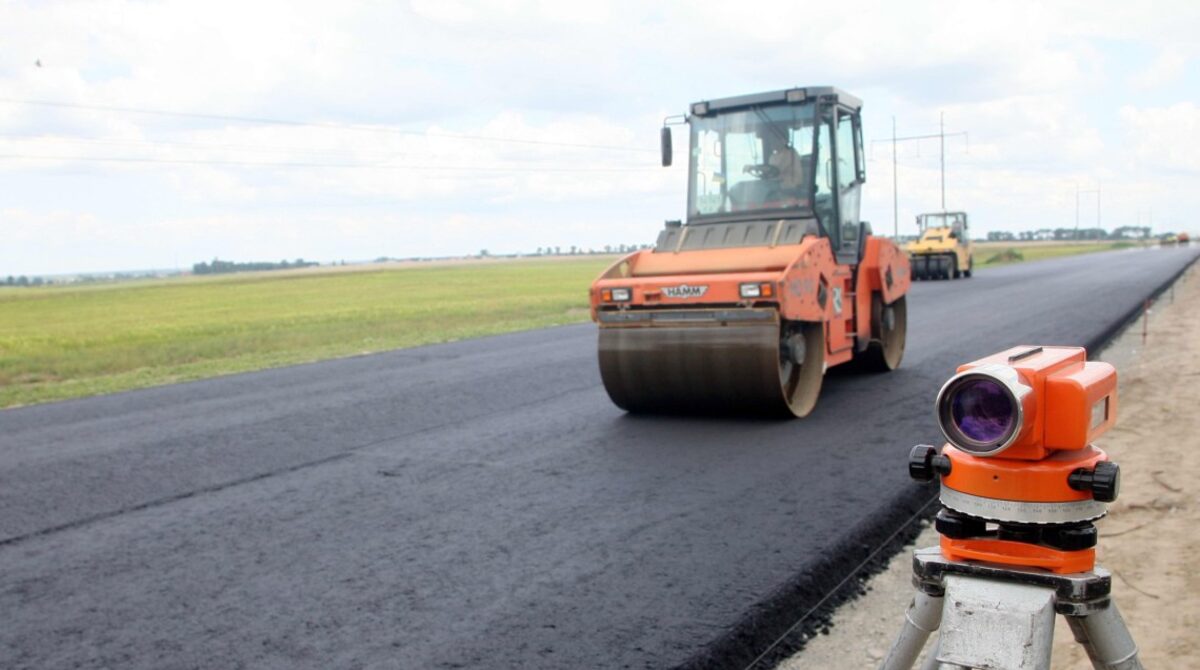
While debates swirl around potential projects, real challenges are concentrated in frontline regions. In Kharkiv region, repairs are ongoing on roads that serve as key routes for military logistics and civilian evacuation. Due to proximity to hostilities and increased drone activity, the load on certain sections has increased three- to fourfold, with traffic intensity exceeding 6,000 vehicles per day. Heavy transport required to supply the front accelerates road deterioration, and on some stretches it is no longer about patching potholes, but partial or even full replacement of the road base, which demands far greater resources and time. Works are carried out by several specialized crews using road milling machines, rollers, and special asphalt thermoses that allow asphalt concrete to be transported and laid even in low temperatures. Maintaining passability on these routes is critically important for defense and humanitarian connectivity, and it is precisely here that funding cuts pose the greatest risk.
At the same time, in more stable regions the state is trying to complete strategic nodes. In Volyn region, the capital repair of the M-07 Kyiv – Kovel – Yahodyn road at the approaches to the international border crossing “Yahodyn – Dorohusk” has been successfully completed. Near Kyiv, construction continues on the transport interchange at the 21st kilometer of the M-05 Kyiv – Odesa highway near Vita-Poshtova, financed by the European Investment Bank and the European Bank for Reconstruction and Development.
Post List




The works are being carried out by Avtomahistral-Pivden, which has had to deal with the legacy of a previous contractor from Azerbaijan. The company openly speaks about quality issues: “We became convinced of the quality of the work performed by our colleagues from Azerbaijan back at the tunnel interchange. For several months we had to blush, restricting traffic on the Odesa highway, in order to restore the monolithic slab left behind by our predecessors,”the company said. As a result, a decision was made to dismantle the central support of the ‘horseshoe’ and build a new one, as well as to change the exit scheme from Vita-Poshtova.
A separate signal for the sector came from Zakarpattia region, where prosecutors prevented an attempt to recover UAH 32 million from the state budget for allegedly completed but in fact uncommissioned and unconfirmed road maintenance works. The Supreme Court supported the state’s position, finally stopping the creation of a fictitious debt. This case demonstrates that in conditions of funding shortages, control and legal integrity are no less important than the financing itself.
The extended conclusion of Time for Action is that Ukraine’s road sector is entering 2026 in a state of severe survival mode. Funding cuts to the lowest level since the start of the war, accumulated debts, increased pressure on frontline roads, and dependence on donor funds are forcing the state to make painful choices between maintaining critical routes and abandoning development. Scandals around projects like the Bukovel road only underline how sensitive the issue is for society. In these conditions, the decisive factor is not the number of new construction projects, but clear prioritization, strict control over spending, and concentration of resources where roads directly affect defense, evacuation, and the country’s economic resilience. Without this, even the limited available funds risk being dispersed without delivering a systemic result.
About the Author

Related posts:
 Budget, Reforms and Risks: The Key Financial Challenges Facing Ukraine in 2026
  Ukraine’s 2026 Budget: How the state plans to fund defense, education, healthcare, veterans, and business
  Defense Budget 2025: How Parliament Dramatically Increases Military Funding
  State Budget-2026: The Main Financial Document of the War